
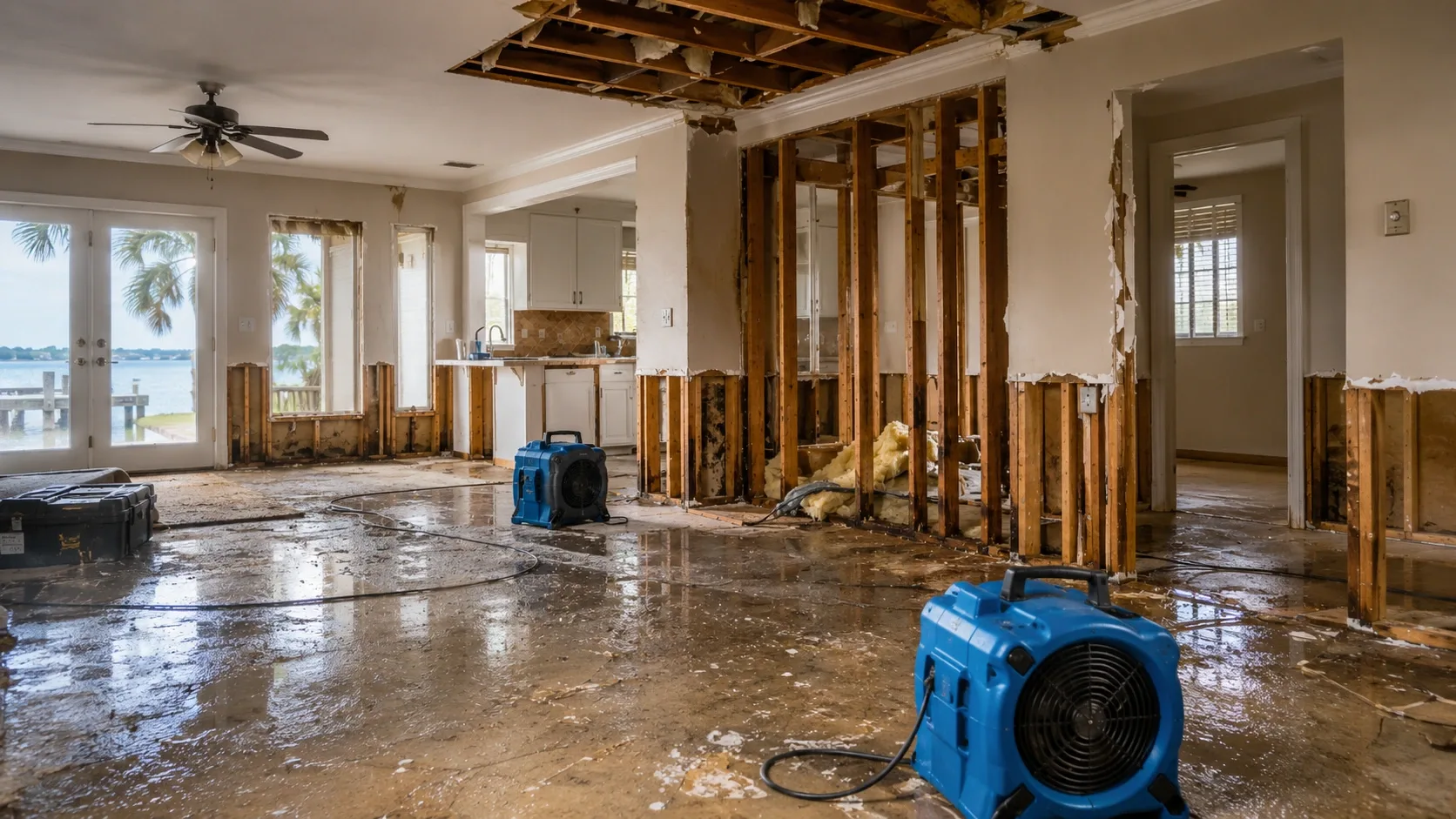
When you file a property damage claim without representation, the insurer's adjuster documents your loss from their employer's perspective, not yours. A licensed public adjuster works exclusively for you, performing an independent inspection, reviewing every applicable coverage in your policy, and negotiating directly with the carrier to pursue the settlement your damage actually warrants.
Key Takeaways
- The insurer's adjuster builds a file that supports their employer's offer, not your full recovery.
- Low initial offers typically result from incomplete documentation, not necessarily bad faith.
- A free consultation tells you whether your claim has recoverable value before you commit to anything.
Why Does Your First Insurance Offer Usually Come In Low?
The insurer's adjuster isn't working against you. They're just not working for you.
When your carrier sends someone to assess your property, that person is trained to document damage within the scope of what the insurer expects to pay. They're not reading your policy looking for coverage you didn't know you had. They're building a file that supports the number their employer wants to put forward. That's not an accusation of dishonesty. It's simply how the incentives are structured on their side of the table.
The mechanics behind a low offer follow a predictable sequence. Damage that isn't fully catalogued doesn't get priced. Policy language that isn't read carefully produces exclusions that shouldn't be there. Repair estimates built on an insurer's preferred vendor schedule don't reflect what local contractors are actually charging right now. None of that requires anyone to act in bad faith. It's what happens when the person doing the inspection answers to the carrier, not to you.
A public adjuster corrects that imbalance. They perform an independent inspection, document every visible and reasonably concealed loss, review your policy for all applicable coverages, and construct a competing estimate at current market rates. Understanding how the claim process works before you're already deep in it changes how you respond to every step the insurer takes.
What Does Thorough Representation Actually Look Like?
Strong advocacy isn't about being combative. It's about being thorough in ways the insurer's standard review process isn't designed to be.
Consider what typically happens with a hurricane claim in Florida. An insurer's adjuster visits, photographs what's visible, produces a repair estimate based on surface observations, and the file moves toward closure. A public adjuster approaching that same property starts from a different place entirely. In many cases, the most consequential damage isn't the damage you can see from the doorway. Moisture absorbed into attic insulation may not show up as staining below for weeks. Trapped water inside wall assemblies often doesn't surface until after repairs are already underway. And current Florida building codes may require upgrades during reconstruction that the insurer's estimate never accounted for. Each of those items can represent legitimate, covered scope that simply didn't make it into the original offer.
That's not a rounding error. It's a fundamentally different outcome.
Otero Property Adjusting and Appraisals, based in Pensacola with more than seven years of Florida-specific experience, starts every case with a free consultation to review both the damage and the existing claim. From there, the team performs a detailed independent inspection, prepares thorough written documentation, reviews the policy for every applicable coverage, builds a repair estimate at current market rates, and manages all communication with the carrier until the claim is resolved. Their full approach is outlined on the Florida Public Adjuster Services page.
The Three Factors That Drive Real Outcome Differences
Most policyholders frame the comparison simply: initial offer versus final settlement. That framing is accurate but incomplete. The real driver is the gap between what the insurer's file contains and what your property's actual damage record should contain. A wide gap produces a low offer. Closing that gap is the job.
Three factors determine how much of that gap can be recovered.
Inspection depth. Surface reviews miss concealed moisture, structural movement, and code-compliance requirements. A public adjuster spending several hours on a property finds things a brief insurer inspection won't. Knowing how to recover from water damage is one challenge. Knowing what water damage your policy actually covers is a separate one entirely, and the two are easy to conflate until something gets excluded from your settlement.
Policy fluency. Florida homeowners policies contain coverage provisions most policyholders never read closely. Additional living expenses, code upgrade coverage, debris removal, and contents replacement all carry specific triggering conditions. Missing one means leaving money behind that was always yours to claim.
Estimate construction. Repair estimates aren't just material lists. They include labor rates, contractor overhead, and current local market pricing. Knowing how to estimate value for an insurance claim in a Florida context is a skill built from working real claims in this market. An estimate built at present Pensacola or Miami contractor rates looks very different from one built on an insurer's preferred vendor schedule.
How Filing Alone Compares to Professional Representation
The honest comparison isn't between a public adjuster and some ideal do-it-yourself outcome. It's between professional representation and what most policyholders actually experience when they navigate this process without help.
| Factor | With Otero Property Adjusting | Filing On Your Own |
|---|---|---|
| Damage documentation | Full independent inspection and written record | Insurer's adjuster only |
| Policy review | Detailed review for all applicable coverages | Your own reading of a complex document |
| Repair estimate | Independent estimate at current market rates | Insurer's preferred vendor pricing |
| Negotiation | Licensed advocate managing all communication | You, negotiating directly with the carrier |
| Risk of leaving covered value behind | Significantly reduced | High on complex claims |
| Time and effort required from you | Minimal | Substantial |
Filing alone isn't free. The real cost is the gap between what you recover and what you were actually owed.
There's also a tactical dimension worth knowing before you speak with the carrier directly. What you say to an adjuster during the early stages of a claim matters as much as what you document. Statements made before the full scope of damage is established can limit what gets covered later, and there's no undoing them once they're part of the record.
Who Gets the Most Out of This Kind of Representation?
Professional representation produces its strongest results in specific situations.
Claims where the initial offer is clearly below actual repair costs. Properties with multiple damage types from a single event, such as hurricane wind combined with water intrusion. Commercial or rental properties where business interruption is part of the loss. Claims that have already been delayed, partially denied, or denied outright.
Florida properties from Miami to Pensacola regularly face layered combinations of wind, rain, and moisture damage that a standard insurer review frequently misses. If your property experienced fire damage, understanding how house insurance works after a fire and what your policy actually covers are questions worth answering before you accept any offer. The same applies to water damage situations where secondary issues like mold become part of the picture. Knowing whether mold is covered under your home insurance affects how you document and present the full scope of your loss.
Here's what most policyholders get wrong. You don't know which category you're in until someone who knows what to look for has actually reviewed your property and your policy. That's exactly what the free consultation is designed to tell you.
What This Process Can't Do
No public adjuster can guarantee a specific outcome. The final settlement depends on what the policy actually covers, what the damage documentation supports, and how the insurer responds to negotiation.
Otero Property Adjusting and Appraisals will tell you honestly what they find and what they believe is recoverable. They won't promise a number they can't support. That's what honest advocacy looks like.
The process also takes time. If you need funds in hand within days, the claims process won't move that fast even with strong representation. What professional representation does is make sure that when the settlement arrives, it reflects what you were genuinely owed, not what was easiest for the insurer to put in writing.
Frequently Asked Questions
How do I know if my insurance offer is actually too low?
The clearest signal is a gap between what the insurer offered and what local contractors are quoting for the same repairs. If contractors are telling you the work will cost significantly more than the insurer's number, that difference is worth a conversation. A free consultation with a public adjuster tells you whether the gap is recoverable or whether the insurer's number is actually defensible.
Does hiring a public adjuster slow down my claim?
Not when you engage one early. Having a licensed advocate managing documentation and communication typically keeps things moving because the insurer receives a complete, professionally prepared file rather than a piecemeal submission. Delays usually come from incomplete documentation or scope disputes, and professional representation helps reduce both.
Can a public adjuster help if my claim has already been denied?
Yes. A denial isn't the end of the road. A public adjuster can review the denial, identify whether it was based on incomplete documentation or a disputed policy interpretation, and re-enter the claim with additional support. Florida's claims process includes formal mechanisms for challenging denials, and having experienced Florida public adjuster services behind you during that challenge changes the dynamic considerably.
What's the difference between a public adjuster and an insurance attorney?
A public adjuster handles the claims process: inspection, documentation, estimation, negotiation, and settlement. An insurance attorney handles litigation when the insurer acts in bad faith or a claim goes to court. Most claims are resolved through the public adjuster's process without legal action ever becoming necessary. If a claim does escalate, the public adjuster's thorough documentation becomes the foundation an attorney builds on.
How quickly should I contact a public adjuster after damage occurs?
As soon as the property is safe to assess. The earlier a public adjuster gets involved, the more complete the documentation of original damage conditions. Waiting until after the insurer's adjuster has visited and produced an offer means working from a file the carrier built. Starting with your own independent documentation is always the stronger position.
Does Otero Property Adjusting serve areas outside of Pensacola?
Yes. Otero serves Florida homeowners and business owners across the state, from Miami to Pensacola, covering hurricane-exposed coastline and inland areas alike. Hurricane damage, storm damage, fire, and water intrusion claims all fall within their scope, regardless of where in Florida the property is located.
The insurance company already has someone working their side of your claim. The only question is whether you have someone working for you.
If your initial offer doesn't reflect what repairs will actually cost, contact Otero Property Adjusting and Appraisals for a free consultatio$1,$2no obligation, and a straight answer about what your claim is worth. Call 850-285-0405 or visit oteroadjusting.com.