
The insurance company has made its offer. You’ve looked at the number, looked at the damage, and something doesn’t add up. That gap – between what you’re owed and what you’re offered – is not an accident.
Direct Answer
A public adjuster in Florida is a licensed professional who represents policyholders – not insurance companies – in the claims process. For losses above $10,000, complex damage types, or any claim where the initial offer feels low, hiring a public adjuster typically produces a larger settlement than going it alone. The fee (capped by Florida law at 10-20% of the claim payment) comes out of the recovery, not your pocket upfront.
Key Takeaways
- Florida law caps public adjuster fees at 10% during the first year after a Governor-declared emergency, and 20% for standard claims – you pay nothing upfront
- The Florida Association of Public Insurance Adjusters recommends considering a public adjuster for any loss exceeding $10,000
- Your insurance company’s adjuster works for the insurer – their job is to settle claims efficiently, not maximally
- DIY claims leave money on the table not because homeowners are careless, but because policy language is written to be interpreted narrowly
- You have 10 business days to cancel a public adjuster contract after signing – Florida law protects you if you change your mind
Why Does the First Insurance Offer Almost Never Reflect Full Value?
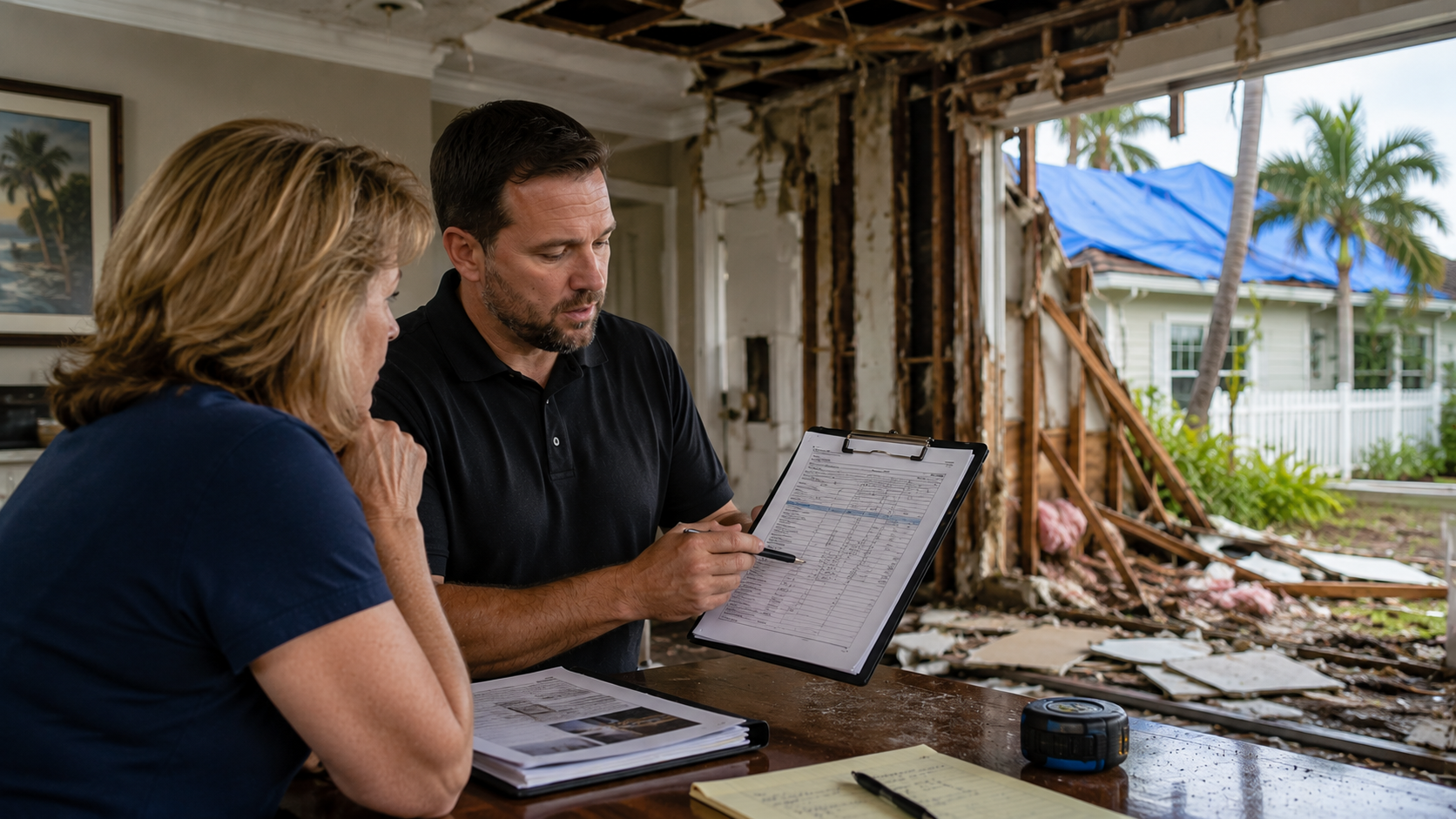
Here’s the root cause most people miss: the insurance company’s adjuster isn’t your adversary in a personal sense. They’re following a process. That process is designed to move claims through quickly, document visible damage, and apply standard repair rates. It is not designed to find everything you’re owed.
The mechanism that drives underpayment isn’t bad faith – it’s scope limitation. An insurance adjuster documents what they can photograph and measure on a single visit. Smoke migration into wall cavities, water intrusion behind tile, structural movement from wind loading – these don’t show up in a standard walk-through. They show up when someone who knows what to look for spends real time on the property.
That’s the actual problem. Not that the insurer is lying. That their process has a built-in ceiling, and your claim gets measured against that ceiling, not against your full loss.
What Are the Real Alternatives – and What Does Each One Cost You?
Let’s be direct about what your options actually are.
Option 1: Accept the initial offer and move on.
This is the most common choice. It’s also the one insurance companies benefit from most. If the damage is minor, the claim is straightforward, and the offer covers actual repair costs, this is fine. But if you’re reading this article, that probably isn’t your situation.
Option 2: Handle the claim yourself and negotiate.
You can push back. You can get contractor estimates, write letters, request reinspections. Some people succeed at this. Most don’t – not because they’re not smart, but because they don’t know what line items are negotiable, what documentation triggers a higher payout, or how to counter the insurer’s depreciation calculations. The insurer’s team does this every day. You’re doing it once, while also dealing with a damaged home or business.
Option 3: Hire a public attorney (property insurance attorney).
An attorney can file suit and force action. This is the right tool when a claim has been denied outright or when bad faith is clearly in play. It’s slower, often more expensive (attorney fees can exceed public adjuster fees), and the litigation timeline can stretch into years. For claims that are underpaid but not denied, it’s usually the wrong first step.
Option 4: Hire a public adjuster.
A public adjuster is a licensed claims professional who works exclusively for policyholders. They document your loss, interpret your policy, prepare the claim, and negotiate directly with the insurer. The fee is contingency-based – they only get paid when you do. According to the Florida Department of Financial Services, fees are capped at 10% of the claim payment for the first year after a declared state of emergency, and 20% thereafter for standard claims.
The Florida Association of Public Insurance Adjusters recommends this route for any loss exceeding $10,000 – and that threshold is lower than most people assume.
The Tradeoff Table: What Each Path Actually Delivers
| Approach | Who Represents You | Upfront Cost | Typical Speed | Best For |
| Accept initial offer | Nobody | $0 | Immediate | Minor claims, clear-cut damage, offer covers full repair cost |
| DIY negotiation | You | $0 | Weeks to months | Small claims where you have time, documentation skills, and policy knowledge |
| Public adjuster | Licensed PA on your side | $0 upfront; % of settlement | Weeks to months | Underpaid claims, complex damage, multi-peril losses, any claim above $10,000 |
| Property insurance attorney | Attorney | Varies; often contingency | Months to years | Denied claims, bad faith situations, litigation-stage disputes |
The table makes one thing clear: the cost of not having representation isn’t a fee – it’s the difference between what you’re offered and what you’re actually owed.
What Does a Public Adjuster Actually Do That You Can’t?
This is the follow-up question most people have after they understand the basic concept, so it’s worth being specific.
A public adjuster doesn’t just “help with paperwork.” They perform a full scope-of-loss assessment – meaning they document every damaged component, cross-reference it against your policy’s coverage language, and build a claim file designed to withstand the insurer’s scrutiny. They know which line items insurers routinely undervalue (contents depreciation, code upgrade requirements, debris removal) and which documentation triggers a higher payout.
Consider a common scenario: a homeowner in the Panhandle files a hurricane claim. The insurer’s adjuster documents roof damage and some interior water intrusion. The initial offer is $28,000. A public adjuster reinspects and identifies additional wind-driven water damage behind exterior walls, damaged HVAC components, and code-required upgrades the insurer didn’t include. The revised claim comes in significantly higher. The public adjuster’s fee is paid from the increased settlement – the homeowner nets more even after the percentage.
That’s the mechanism. Not magic. Scope, documentation, and policy knowledge applied systematically.
If you’re in the Pensacola area or anywhere across the Panhandle, Otero Property Adjusting & Appraisals Inc does exactly this work – and they do it without charging you anything until your claim is settled. You can see how they approach public adjuster services in Pensacola, FL or review their loss consulting services in Florida if you’re still figuring out what kind of help fits your situation.
Who Should Think Twice Before Hiring a Public Adjuster?
Honest answer: if your claim is genuinely small and the damage is limited to one clearly visible item – a broken window, a single damaged appliance – the insurer’s offer may actually be fair, and a public adjuster’s percentage wouldn’t make financial sense for either party.
The fit question isn’t really about the type of damage. It’s about the gap between what you’re offered and what a thorough claim would produce. If that gap is real, the fee pays for itself. If the claim is already settled correctly, there’s no gap to close.
What a public adjuster can’t do: they can’t manufacture coverage that isn’t in your policy, and they can’t guarantee a specific outcome. What they can do is make sure everything that is covered gets documented, valued correctly, and negotiated aggressively.
Otero Property Adjusting & Appraisals Inc is straightforward about this. They’ll tell you whether your claim warrants representation before you sign anything. That’s the kind of conversation worth having before you accept a number that doesn’t feel right.
The Framework: When to Hire a Public Adjuster vs. When to Handle It Yourself
Call this the Gap-Severity Test. It has two variables:
Claim complexity – Is the damage multi-system (roof + interior + contents + code upgrades)? Is the cause disputed? Is there hidden damage that requires specialist documentation?
Settlement gap – Does the initial offer cover your actual repair costs, or does it fall short?
Use a public adjuster when: complexity is high OR the gap is real. Use one especially when both are true.
Handle it yourself only when: the claim is a single, clearly visible item, the insurer’s offer matches contractor estimates, and the loss is under $10,000.
The threshold matters. FAPIA puts it at $10,000 for a reason – below that, the math on a percentage fee gets tight. Above it, the math almost always favors representation.
What Happens After You Hire a Public Adjuster in Florida?
Another question people ask immediately: what does the process actually look like?
After you sign a contract, the public adjuster takes over communication with your insurer. They inspect the property, build the claim file, and submit a demand. The insurer responds, often with a counter. The adjuster negotiates. Most claims resolve without litigation. The timeline varies – straightforward claims can move in weeks; complex multi-peril claims take longer.
You have 10 business days after signing to cancel the contract with no penalty, per Florida Department of Financial Services rules. That protection exists because the legislature recognized that storm victims are often approached immediately after a disaster, when they’re not in the best position to make careful decisions.
Otero Property Adjusting & Appraisals Inc serves clients across the full stretch of Florida – from Panama City to Jacksonville and down to Tampa. If your property is anywhere in that corridor and the claim isn’t settled to your satisfaction, the conversation costs you nothing.
FAQ
How much does a public adjuster in Florida actually charge?
Florida law caps public adjuster fees at 10% of the claim payment during the first year after a Governor-declared state of emergency, and up to 20% for standard claims. You pay nothing upfront – the fee comes out of the settlement after it’s reached, so there’s no out-of-pocket cost to get started.
Can I hire a public adjuster after I’ve already filed my claim?
Yes. You can bring in a public adjuster at almost any stage – after filing, after receiving a low offer, or even after a partial denial. The earlier the better, but it’s rarely too late to reopen or supplement a claim that was undervalued.
What’s the difference between a public adjuster and the adjuster my insurance company sends?
The insurance company’s adjuster works for the insurer. Their job is to document the loss and settle the claim within the insurer’s guidelines. A public adjuster works exclusively for you. They have no incentive to minimize your claim – their fee is a percentage of what you recover, so a higher settlement is directly in their interest.
Will hiring a public adjuster make my insurance company angry or cause problems with my policy?
No. You have a legal right to representation in the claims process. Insurance companies deal with public adjusters regularly. Having professional representation doesn’t jeopardize your coverage or your relationship with the insurer.
What kinds of damage does a public adjuster handle?
Hurricane and wind damage, water intrusion, fire and smoke damage, storm damage, and any covered peril where the insurer’s initial scope or valuation feels incomplete. Public adjusters are particularly valuable for multi-system damage where the full scope isn’t obvious from a single inspection.
How do I know if my insurance offer is actually too low?
Get a detailed contractor estimate for full repair costs and compare it line by line to the insurer’s scope. If the insurer’s estimate excludes items the contractor includes, or applies heavy depreciation that leaves you short of actual repair costs, that’s a real gap worth addressing. A public adjuster can tell you quickly whether the offer is in the right range.
What if my claim has already been closed?
Closed doesn’t mean final. Florida policies typically allow you to reopen or supplement a claim within the statute of limitations period. If you settled for less than your actual loss and time hasn’t run out, it’s worth having a public adjuster review what was paid versus what was owed.
Stop Leaving the Decision to the Party That Benefits From Your Inaction
The most expensive move after property damage isn’t hiring the wrong help. It’s waiting – or accepting a number because the process felt too complicated to fight. Insurance companies don’t get emotional about settlements. They just keep moving.
If your claim is above $10,000, involves complex damage, or produced an offer that doesn’t match what repairs actually cost, you have a decision to make. Not eventually. Now, while documentation is fresh and options are still open.
Contact Otero Property Adjusting & Appraisals Inc today. Tell them what happened, what you were offered, and what doesn’t add up. That conversation is free. The cost of not having it isn’t.
About the Author
Otero Property Adjusting & Appraisals Inc is a licensed public adjusting firm based in Pensacola, Florida, specializing in property damage claims for homeowners and small business owners across the state. They represent policyholders – not insurance companies – in negotiating fair settlements for hurricane, fire, water, and storm damage claims, with no upfront costs. Otero serves clients from Miami to Pensacola and is known for personalized advocacy, detailed claims documentation, and a track record of securing settlements above initial insurance offers.
References
Florida Department of Financial Services – public adjuster fee caps and contract cancellation rights
Florida Association of Public Insurance Adjusters – when to hire a public adjuster and fee limits