
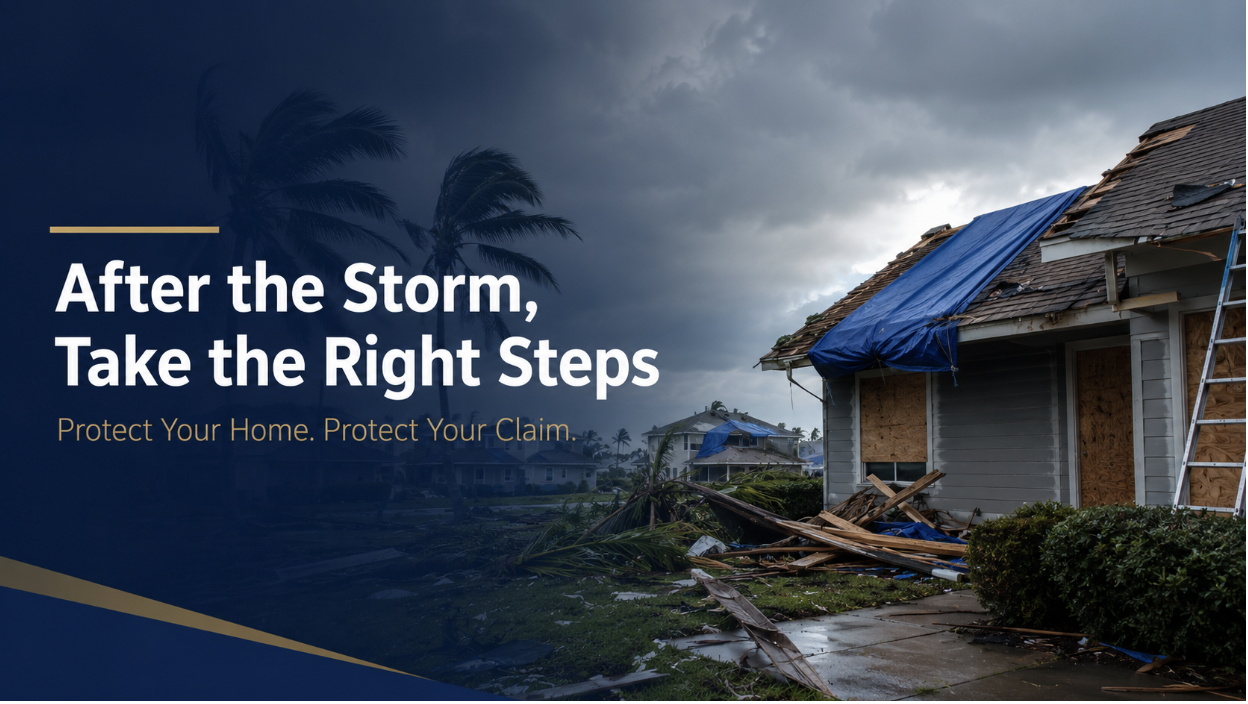
The storm has passed, but the real pressure is just beginning. The decisions you make in the first 48 to 72 hours after property damage in Florida will shape everything that follows – including how much your insurance company pays you.
Direct Answer
After storm damage in Florida, immediately document all visible damage with photos and video before touching anything, report the claim to your insurer within 24-48 hours, and take reasonable steps to prevent further damage using temporary repairs. Avoid signing anything from your insurer without review. Hiring a licensed public adjuster before the insurance company’s adjuster arrives gives you the strongest position for a fair settlement.
Key Takeaways
• Document damage thoroughly with timestamped photos and video before any cleanup begins
• File your claim promptly – Florida’s insurance policies often have strict reporting windows
• Temporary protective measures (tarping, boarding) are required to prevent additional damage, but keep all receipts
• Never accept an initial settlement offer without an independent review – first offers are routinely low
• A licensed public adjuster works for you, not the insurance company, at
What Is Actually Happening When You File a Storm Damage Claim?
Most homeowners believe filing a claim is a neutral process – you report damage, an adjuster comes out, and you get a fair number. That belief is the most expensive mistake you can make.
When you file a Florida storm damage claim, your insurance company immediately assigns an adjuster whose job is to assess damage on behalf of the insurer. That adjuster’s findings directly affect the company’s payout. The mechanism matters here: insurance company adjusters are not adversarial by nature, but their financial incentive and yours are structurally opposed. They are paid to assess. You are trying to recover.
Understanding this distinction is the foundation of every smart decision that follows.
The insurance company’s adjuster works for the insurance company. That is not an accusation – it is a job description. Knowing it changes how you prepare.
What Should You Do in the First 24 Hours After Storm Damage?
Step 1: Prioritize Safety Before Documentation
Before you pick up a phone or a camera, confirm the structure is safe to enter. Downed power lines, gas leaks, and compromised roofing are all real risks after Florida storms. If there is any doubt, wait for clearance from emergency services.
Once it is safe, document everything.
Step 2: Document Damage Before You Touch Anything
This is the step most homeowners skip – and it costs them significantly. Take timestamped photos and video of every affected area before any cleanup, temporary repair, or debris removal. Walk every room. Shoot wide angles and close-ups. Capture damaged personal property, structural damage, water intrusion points, and anything that shows the storm’s path through your home.
The documentation you create in the first hours is often the most powerful evidence in your entire claim. Insurance companies cannot dispute what they can see clearly in your own footage.
Keep a written log alongside your photos: date, time, what you observed, and any immediate safety concerns.
Step 3: Protect the Property From Further Damage
Florida law and most homeowner policies require you to take reasonable steps to prevent additional damage after a covered event. This means tarping a damaged roof, boarding broken windows, and extracting standing water as quickly as possible.
Do this – but document before you do it, and save every receipt. Temporary repair costs are typically reimbursable under your policy, but only if you can prove what was done and what it cost. If water intrusion is involved, understanding how long you should run fans after water damage can make a significant difference in preventing secondary damage while your claim is being processed.
What Are the Most Common Claim Filing Mistakes Florida Homeowners Make?
Waiting Too Long to File
Florida’s insurance policies carry reporting requirements. Waiting days or weeks to file – even while you’re dealing with the immediate chaos – can give insurers grounds to reduce or deny your claim. File as soon as you have documented the damage, even if your full assessment isn’t complete.
Talking Too Much to the Insurance Company Early On
This is the contrarian claim most homeowners don’t expect to hear: being cooperative and forthcoming with your insurer in the first days of a claim can actually work against you. Recorded statements, casual conversations with adjusters, and off-the-cuff estimates of damage can all be used to anchor a lower settlement. You are not legally required to provide a recorded statement in most circumstances. Be polite, be professional – and be careful.
Accepting the First Offer Without Review
Industry experience consistently shows that initial settlement offers on storm damage claims are frequently lower than what the policy actually supports. A homeowner in Pensacola whose roof was damaged by Hurricane Sally received an initial offer that covered partial replacement. After Otero Property Adjusting & Appraisals reviewed the policy language and full scope of damage, the final settlement was significantly higher – covering full replacement plus interior damage the original assessment had missed entirely.
First offers are not final offers. They are opening positions. Knowing how to respond to a low settlement offer before you are sitting across from an adjuster puts you in a far stronger negotiating position.
The STORM Documentation Framework: A Field-Tested Approach to Claim Preparation
The STORM Documentation Framework is a five-step sequence for organizing claim evidence in the critical window between damage and adjuster inspection.
• S – Safety clearance first: Confirm entry is safe before any documentation begins
• T – Timestamped media: Photo and video with device timestamps intact, uploaded to cloud storage immediately
• O – Original condition evidence: Pull any pre-storm photos, home inspection reports, or prior appraisals that establish baseline condition
• R – Receipts and records: Document all emergency expenditures, temporary repair costs, and contractor estimates
• M – Mitigation log: Written record of every protective action taken, when it was taken, and by whom
Use this framework when: you have experienced any storm, fire, or water damage event and have not yet had an insurance adjuster visit.
Do not use this as a substitute for professional claim representation when the damage is significant. Documentation supports your claim. A licensed public adjuster builds and argues it.
How Does Hiring a Public Adjuster Actually Change the Outcome?
A public adjuster is a licensed professional who represents the policyholder – not the insurance company – in the claims process. That distinction is the entire value proposition.
Public adjusters read policy language the way insurance companies read it: carefully, specifically, and with attention to what is and isn’t excluded. They identify damage items that insurance company adjusters routinely miss or undervalue. They understand Florida-specific policy structures, including the nuances of hurricane deductibles, flood exclusions, and the Assignment of Benefits rules that have shaped the state’s insurance landscape.
The mechanism behind better outcomes is not just negotiation skill. It is scope completeness – the difference between an adjuster who documents what is visible and one who documents what the policy covers. Those are not always the same list.
When your insurance company sends their adjuster, they are not sending someone to help you. Otero sends someone who is.
How Does a Public Adjuster Compare to Going It Alone or Using an Attorney?
| Approach | Who They Represent | Upfront Cost | Best For |
| Insurance company adjuster | The insurer | None (to you) | Initial inspection only |
| Insurance attorney | You | Varies; often contingency | Denied claims, litigation |
| Contractor estimate only | Neutral | Varies | Small, straightforward repairs |
For most Florida storm damage claims where the initial offer feels inadequate, a public adjuster is the most direct path to a better outcome – faster than litigation, more thorough than a contractor estimate, and fully aligned with your interests.
What Are the Honest Limitations Here?
Not every situation calls for the same approach.
If your damage is minor – a single broken window, a small section of fence – the cost-benefit of professional representation may not apply.
This guide also does not cover flood damage claims filed through the National Flood Insurance Program (NFIP), which operates under separate rules and timelines. If your damage involves both wind and flood, which is common in Florida hurricane events, understanding what flood insurance does not cover under FEMA can help you avoid costly assumptions about what your policy will actually pay out. The claim process becomes more complex – and professional representation becomes more valuable, not less.
Otero Property Adjusting & Appraisals will tell you honestly whether your situation warrants their involvement. That conversation costs you nothing.
How Should You Communicate With Your Insurance Company After Storm Damage?
Keep every communication in writing when possible. Follow up phone calls with a brief email confirming what was discussed. Do not agree to any inspection time without confirming you or a representative will be present. Do not sign any release, settlement agreement, or proof of loss without understanding exactly what you are agreeing to.
A signed proof of loss that understates your damage can close your claim permanently. That is not a technicality – it is a binding legal document.
Frequently Asked Questions
How long do I have to file a storm damage claim in Florida?
Florida law generally requires insurers to be notified of a claim promptly, and most policies specify a reporting window. While the exact timeframe varies by policy, waiting weeks or months after a storm creates legitimate grounds for coverage disputes. File as soon as you have documented the damage – even if your full scope of loss is still being assessed.
Will filing a claim raise my insurance rates?
It can, depending on your insurer and claim history. However, that concern should never stop you from filing a legitimate claim for significant damage. Failing to file and paying out of pocket for damage your policy covers is a worse financial outcome in most cases. A public adjuster can help you understand the benefits available under your policy before you decide.
Can I hire a public adjuster after I’ve already filed my claim?
Yes. You can bring in a public adjuster at almost any stage of an open claim – including after you have received an initial offer you believe is too low. Otero Property Adjusting & Appraisals handles claims that are already in process, not just new filings.
What is the difference between a public adjuster and a contractor who says they handle insurance claims?
A public adjuster is licensed by the state of Florida specifically to represent policyholders in insurance claims. A contractor can provide repair estimates and may assist with documentation, but they are not licensed to negotiate on your behalf with an insurance company. Contractors who offer to “handle your claim” are operating outside their licensure in most cases.
What if my claim was already denied?
A denial is not always final. Public adjusters can review denied claims for policy interpretation errors, missed coverage, or procedural issues. If the denial cannot be resolved through negotiation, the next step is typically an insurance attorney – but many denials are resolved before reaching that point.
The percentage is disclosed upfront and is regulated by Florida law.
What if the insurance company’s adjuster has already been out and I didn’t document everything first?
You are not out of options. A public adjuster can conduct their own independent damage assessment, review the insurer’s scope of loss for omissions, and identify damage that was missed or undervalued. The insurer’s first inspection is not the final word on what your claim is worth.
You Have Already Waited Long Enough – Here Is the Next Step
If your insurance company’s offer feels wrong, it probably is. The claims process is not designed to be intuitive for homeowners – it is designed for adjusters who do this every day.
Otero Property Adjusting & Appraisals serves homeowners and business owners across Florida from Miami to Pensacola. If you have experienced hurricane, storm, fire, or water damage and you are not confident in what your insurer is offering, contact Otero today for a free, no-obligation review of your claim. There is no cost to find out what you are actually owed.
Call or reach out to Otero Property Adjusting & Appraisals now – before you sign anything.
Contact Otero Property Adjusting & Appraisals
The documentation you create in the first hours after storm damage is often the most powerful evidence in your entire claim – and most homeowners never take it.
References
Florida Department of Financial Services – Policyholder rights, public adjuster licensing requirements, and insurance claim filing guidance for Florida residents.
National Flood Insurance Program (NFIP) / FEMA – Flood insurance claim procedures, coverage distinctions from standard homeowner policies, and disaster recovery resources.
Florida Office of Insurance Regulation – State-specific regulations governing insurance policy requirements, hurricane deductibles, and claims handling standards.