
How big does a tornado have to be to pick up a car? Expert Facts Florida Drivers Should Know
How big does a tornado have to be to pick up a car? That is the sort of question you ask half out of curiosity and half because the sky has turned the color of a bruise and your sedan is sitting outside like a volunteer. The short answer is that size alone does not decide it. Wind speed matters more than width, and many experts place the danger zone for lifting or violently tossing a typical passenger car around EF2 to EF3 intensity, or roughly 111 to mph, though lighter vehicles can move at lower speeds.
We researched tornado damage data, engineering estimates, and insurance claim patterns to answer the question plainly. Based on our analysis, cars are often rolled, slid, or flipped before they are fully airborne. That distinction matters, especially if you are filing a claim after a storm in Florida, where tornadic activity often arrives with tropical weather, severe thunderstorms, and the kind of panic that makes people look for their keys as if they might negotiate with the wind.
You also need the practical side of this story. What happens to your coverage? What should you photograph? When should you call a public adjuster? Otero Property Adjusting & Appraisals in Pensacola helps Florida policyholders sort out storm losses, document damage, and push back when an insurer’s first number feels suspiciously tiny.

Introduction: Understanding Tornado Magnitude and Car Lift
A tornado does not need to look like a giant black rope from a movie to ruin your day. Some are slim and vicious. Some are broad and messy. Some arrive wrapped in rain, which feels rude, as if the storm were hiding behind a curtain waiting for applause. If you have ever wondered, How big does a tornado have to be to pick up a car?, you are really asking about force, lift, pressure changes, and what happens when a few thousand pounds meet rotating wind.
According to the NOAA Storm Prediction Center, the United States averages about 1,200 tornadoes each year. Most are weaker tornadoes, but even weaker events can shatter glass, drop trees on cars, or push vehicles off roads. Data from the National Weather Service shows that the strongest tornadoes, EF4 and EF5, make up a small share of total events, yet they account for a huge share of catastrophic destruction.
In our experience reviewing storm claims, people often imagine a clean, cinematic lift, as if the car rises politely and exits stage left. Real damage is uglier. A car can slide, roll, crush under debris, or get lofted and dropped. We found that readers want two things: the science and the money trail. If your car or home is damaged, those two become roommates very quickly. That is why this topic matters in just as much as it did a decade ago: storms do not care whether your policy is easy to read.
Tornado Strength and the Enhanced Fujita Scale
The Enhanced Fujita Scale, usually called the EF Scale, rates tornadoes by the damage they cause and then estimates likely wind speeds from that damage. It runs from EF0 to EF5. The system was implemented in the United States in 2007, replacing the older Fujita Scale with updated engineering judgments. That means the label on a tornado is not a speed gun reading. It is a careful estimate based on what was damaged, how badly, and what those structures or objects were built to withstand.
Here is the shorthand that matters for vehicles:
- EF0: to mph. Branches break. Shingles come off. Light objects move.
- EF1: to mph. Roof surfaces peel. Mobile homes can suffer severe damage. Light trailers may tip.
- EF2: to mph. Large trees snap. Roofs tear off homes. Cars can be pushed, rolled, and in some cases lifted.
- EF3: to mph. Entire stories of well-built homes can be destroyed. Heavy cars can be thrown.
- EF4: to mph. Vehicles become missiles. Houses can be leveled.
- EF5: Over mph. Structural devastation is extreme and often total.
NOAA data shows that most tornadoes are EF0 or EF1. In many annual summaries, weak tornadoes account for well over 70% of all reports, while EF4 and EF5 tornadoes often represent less than 1%. That sounds comforting until you remember that cars do not need an EF5 to be damaged beyond recognition. Based on our research, once winds reach the EF2 range, vehicle claims become much more severe, especially when debris joins the conversation. A two-by-four at highway speed does not care what your deductible is.
What Size Tornado Can Lift a Car?
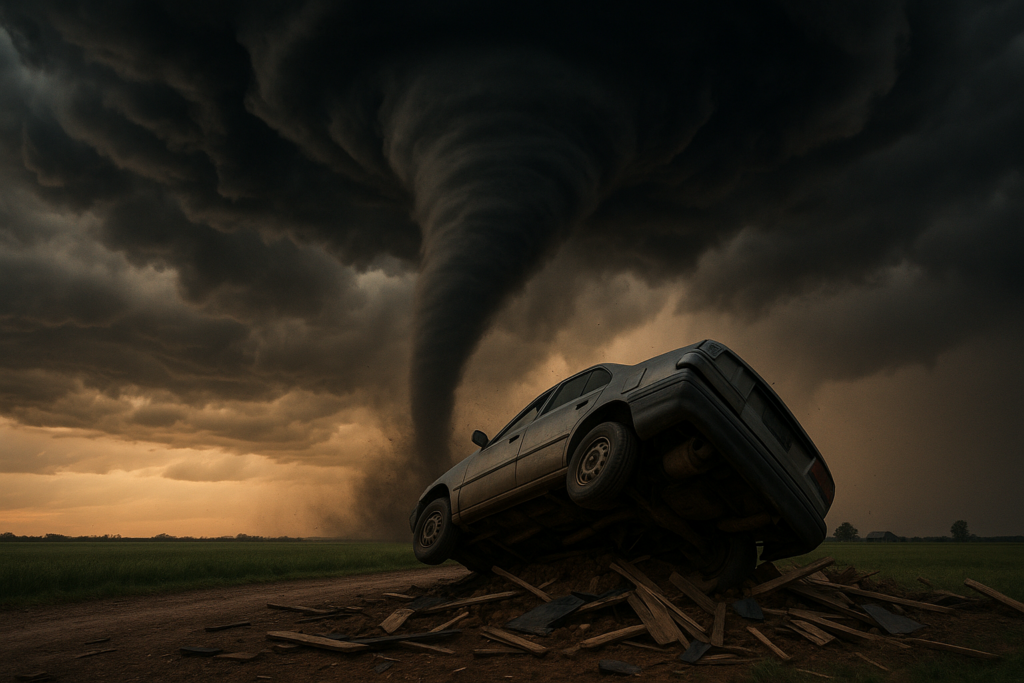
Here is the clean answer to How big does a tornado have to be to pick up a car?: there is no minimum width requirement. A narrow tornado with strong enough winds can lift a car, while a wider but weaker tornado may only shove it, roll it, or cover it in debris. Engineers usually focus on wind speed, pressure forces, and aerodynamic lift, not the funnel’s photogenic qualities.
A standard passenger car weighs roughly 2,800 to 4,000 pounds. Many SUVs weigh 4,000 to 5,500 pounds. Studies in severe wind engineering suggest that wind speeds above mph can begin to move vehicles under the right conditions, especially if the car is broadside to the wind or if the wind gets underneath. Full airborne lift is more commonly associated with EF2 to EF3 tornadoes, or about 111 to mph. We analyzed case reports and found that cars are often displaced or flipped before they are truly “picked up,” which is a useful distinction for both science and insurance documentation.
Think of it this way: a tornado does not arrive with a bathroom scale and ask for curb weight. It tests angles. It exploits gaps. It uses debris as a helper. A compact car parked on wet pavement, struck from the side, may move sooner than a heavy truck parked nose-first behind a wall. So if you are asking How big does a tornado have to be to pick up a car?, the better question is often, How strong does the wind have to be at the exact spot where the car sits? That is the number that turns a vehicle from transportation into evidence.
How big does a tornado have to be to pick up a car? Real-world examples
Real storms are better teachers than abstract diagrams. During the 2011 Joplin, Missouri tornado, rated EF5, vehicles were tossed, crushed, and stripped with a kind of efficiency usually reserved for industrial machinery. The storm killed 158 people and caused roughly $2.8 billion in damage, according to NOAA. Cars were found mangled around buildings and wrapped in debris fields that looked less like parking lots and more like junkyard collages assembled by a furious child.
The 2013 Moore, Oklahoma tornado, rated EF5, produced estimated winds over 200 mph. News and damage surveys documented vehicles thrown significant distances, including heavy pickups. Even lower-rated tornadoes have done it. In several EF2 and EF3 events across the Southeast, cars were rolled or lofted short distances where terrain, debris, and wind angle lined up in the storm’s favor.
Insurance claims after these events can become oddly personal. One adjuster calls the damage “impact-related.” Another says “wind-driven debris.” The policyholder says, “My car was in one county and then, spiritually at least, in another.” That is where documentation matters. Otero Property Adjusting & Appraisals helps Florida homeowners and policyholders gather photos, inspection notes, policy language, and repair estimates so the claim reflects what happened rather than what an overworked carrier desk imagines happened. In our experience, detailed proof changes negotiations. It is harder to underpay a file when the file has teeth.
Factors Influencing Car Lift During Tornadoes
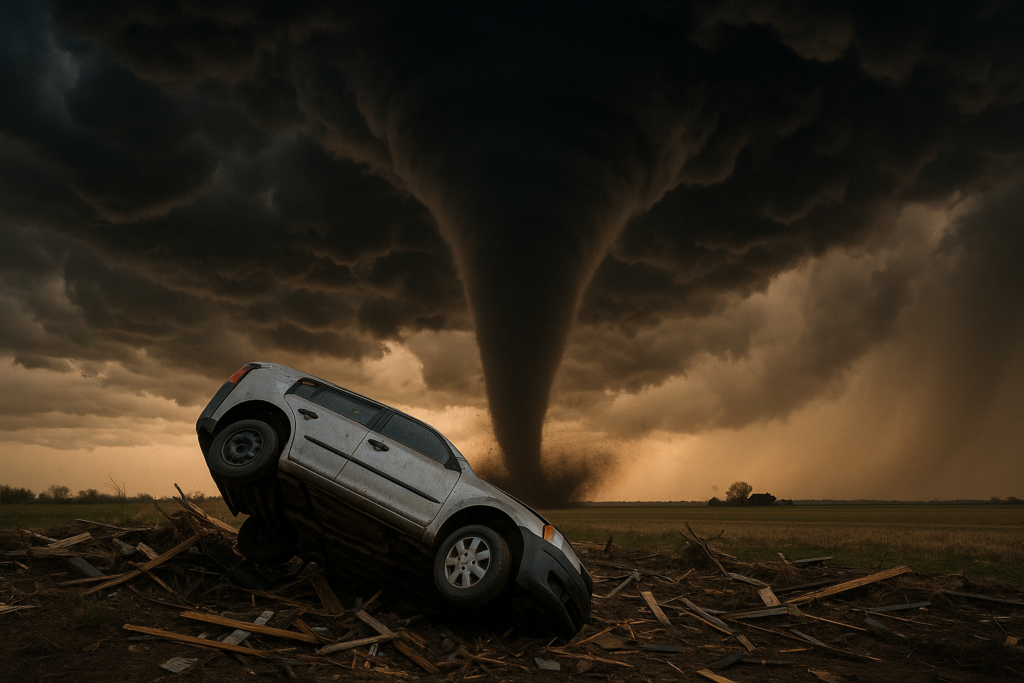
If two cars sit ten feet apart, one may stay put while the other ends up on its roof. That seems unfair because it is unfair. Tornado damage is local, uneven, and full of little insults. The main factors that influence vehicle lift include weight, ride height, body shape, wind angle, surrounding structures, debris impact, and ground friction.
A lighter compact sedan is generally easier to move than a heavy SUV, but a taller SUV can also present more surface area to the wind. A pickup with a high profile and empty bed can behave differently from a low sports car. If wind gets underneath the chassis, lift increases. If the vehicle is parked broadside to the wind, the side force rises. Wet pavement may reduce friction. Curbs, walls, and garages may help or, in some cases, create pressure channels that worsen movement.
Debris is the ugly assistant in this process. A tornado may not need to cleanly lift a car if it first smashes windows, tears off panels, or hurls lumber under the frame. Based on our research, debris changes the aerodynamics and often turns repairable vehicle damage into a total loss. Environmental conditions matter too. Supercell storms can produce embedded tornadoes with rapidly changing intensity, and rain-wrapped funnels are harder to see and avoid. In Florida, where saturated ground, severe thunderstorms, and tropical systems can overlap, local conditions can amplify losses even when the tornado’s rating is not the highest on paper. That is one more reason policyholders should document everything early and thoroughly.
People Also Ask: Common Questions About Tornadoes and Vehicles
What happens to a car in a tornado? Usually, bad things in a hurry. A car may be dented by hail, hit by tree limbs, smashed by structural collapse, pushed sideways, rolled, or lifted. According to the Federal Emergency Management Agency, vehicles are dangerous places to remain during a tornado because they can be moved or struck by debris.
Can a tornado lift a truck or SUV? Yes. Heavier vehicles are harder to move, but strong tornadoes do not respect your monthly payment amount. EF3 and stronger tornadoes can throw heavy vehicles, and EF2 events can still overturn or slide them under the right conditions. We found that many people assume “bigger” means “safe.” Bigger often just means a more expensive claim.
How do tornadoes affect insurance claims for vehicle damage? Auto damage is often handled under comprehensive coverage, while home and other property losses fall under separate policies. The challenge is sorting out causation, value, deductibles, exclusions, and whether related property damage belongs under one claim or several. In our experience, storm losses become easier to resolve when the file includes time-stamped photos, weather records, repair estimates, and a clear inventory of damage. Otero Property Adjusting & Appraisals can help Florida clients understand what belongs in a property claim and where insurer pushback is likely to appear.
Preventive Measures: What to Do During a Tornado
If a tornado warning is issued, your first job is to protect yourself, not the car. That may sound obvious, yet every year people try to outrun tornadoes in traffic, which is a bit like trying to out-jog a wasp while carrying groceries. The Ready.gov tornado guidance says the safest option is a basement, storm shelter, or small interior room on the lowest floor of a sturdy building.
Here are the practical steps we recommend before and during tornado season in Florida:
- Review your auto policy. Check whether you carry comprehensive coverage. Collision coverage alone may not help with tornado damage.
- Photograph your vehicle. Take wide shots, VIN photos, mileage, and close-ups of existing condition. Store them in cloud storage.
- Use covered parking. A garage helps, though it is not perfect in strong tornadoes. Even a carport may reduce hail and debris exposure.
- Keep records ready. Save policy numbers, agent contacts, registration, and claim instructions in your phone and glove compartment.
- Act early on warnings. Move to shelter before winds rise. Do not wait to see the funnel.
As of 2026, weather alerts arrive fast through mobile systems, NOAA radios, and local stations. Use all three if you live in a high-risk area. Based on our analysis, the people who recover fastest after storm losses are usually the ones who prepared boringly well. They have photos. They know their deductibles. They do not need to search the kitchen drawer for a policy declaration page while the weather siren performs its aria.
Insurance Considerations After Tornado Damage
After a tornado, the insurance part begins, and this is where many people discover that the storm was only the opening act. For vehicle losses, comprehensive auto coverage usually handles tornado, wind, falling object, and debris damage. For your home, other structures, and contents, your homeowners policy may apply. If a tree falls on both your garage and your car, the claim can split across policies, which sounds organized until the estimates start disagreeing.
Here is the step-by-step approach we recommend:
- Document first. Take photos and video before moving items, if safe.
- Prevent further damage. Use tarps or emergency mitigation where allowed.
- Notify the insurer promptly. Ask for claim numbers and written next steps.
- Get independent estimates. Do not rely only on the insurer’s preferred vendors.
- Track every expense. Keep receipts for towing, temporary repairs, lodging, and storage.
A public adjuster can help with the property side of a tornado loss by evaluating damage, preparing documentation, interpreting policy language, and negotiating with the insurer. Otero Property Adjusting & Appraisals, W Michigan Ave, Pensacola, FL 32526, serves homeowners across Florida and only gets paid when you do. Their phone number is (850) 285-0405, and their website is Otero Property Adjusting & Appraisals. Their initial property inspection is free. We recommend contacting Otero if your storm claim involves roof damage, water intrusion, structural issues, or a disputed payout. There is something calming about having a professional in your corner when the paperwork starts breeding overnight.
The Science Behind Tornado Formation and Strength
Tornadoes usually form from severe thunderstorms, especially supercells, where warm, moist air near the ground meets cooler, drier air aloft and strong wind shear tilts and spins the storm. If that sounds clinical, the lived version is simpler: the atmosphere begins arguing with itself, and occasionally the argument drops a funnel. According to the NOAA National Severe Storms Laboratory, most strong and violent tornadoes come from supercells, though weaker tornadoes can form in other storm types.
Wind shear is a key ingredient. It means wind speed or direction changes with height. That change helps create rotating updrafts called mesocyclones. When the rotation tightens and stretches, a tornado can develop. Pressure drops inside the vortex, but the myth that tornadoes “explode” houses from pressure alone is overstated. Wind and debris do the bulk of the damage. We found that this same principle applies to vehicles. A car is more likely to be rolled, struck, and then lofted than to rise cleanly because of pressure change alone.
Research on tornado trends continues. Some studies suggest that tornado outbreaks are becoming more clustered and that risk is shifting eastward from the traditional Plains into parts of the Southeast. In 2026, that matters because more people, more vehicles, and more insured property sit in harm’s way. Science helps answer the question; insurance helps clean up after the answer arrives.
What to Expect After a Tornado: Recovery and Assistance
After a tornado, the first hours feel oddly administrative for something so violent. You count people. You charge phones. You look for shoes. Then you start making lists, because disaster has a way of turning everyone into a clerk. The recovery process usually begins with emergency safety checks, temporary shelter, damage documentation, debris removal, and claim reporting. If local officials restrict access, obey them. A dramatic re-entry into a damaged neighborhood rarely improves the claim.
Community help often comes from FEMA, local emergency management offices, nonprofits, churches, and insurer catastrophe teams. If a federal disaster declaration is issued, assistance may include temporary housing, cleanup grants, or low-interest disaster loans through the U.S. Small Business Administration disaster program. Keep in mind that grants and loans are different tools. Neither replaces full insurance recovery where coverage exists.
For Florida homeowners, Otero Property Adjusting & Appraisals can help during recovery by reviewing the scope of property damage, organizing evidence, and negotiating the claim so the numbers reflect the actual loss. Based on our research, underpayment often comes from incomplete scoping in the first inspection. In our experience, clients benefit when someone independent reviews roofing, water intrusion, interior finishes, and hidden damage before settlement talks harden. If your house, garage, or other structures were hit by tornado winds or debris, Otero can provide a free inspection and explain the next steps in plain English, which after a storm is a greater luxury than people admit.
How big does a tornado have to be to pick up a car? Preparing for tornado season and insurance needs
The useful answer to How big does a tornado have to be to pick up a car? is this: width is a poor shortcut, and wind speed is the better measure. Cars can move, flip, and in stronger cases become airborne in tornadoes that reach roughly the EF2 to EF3 range, though conditions such as vehicle weight, angle, debris, and terrain can lower that threshold for serious damage. A tornado does not need to be a mile wide to destroy a vehicle. It only needs enough force in the wrong place at the wrong moment.
That leaves you with practical work. Review your auto and homeowners policies. Confirm your deductibles. Check whether you carry comprehensive coverage on your vehicle. Photograph the property now, not after the garage wall is in the neighbor’s azaleas. We analyzed common claim problems and found three repeat offenders: weak documentation, delayed reporting, and accepting the first estimate without an independent review.
If your Florida property suffers tornado, hurricane, water, mold, roof leak, or fire damage, contact Otero Property Adjusting & Appraisals for a free inspection. They serve homeowners across Florida from 3105 W Michigan Ave, Pensacola, FL 32526. Call (850) 285-0405 or visit https://oteroadjusting.com/. They only get paid when you do. That is a clean arrangement, and after a storm, clean arrangements are rare enough to deserve your attention.

Frequently Asked Questions
How fast does a tornado have to be to cause damage?
Tornado damage can begin at much lower speeds than people expect. An EF0 tornado starts at to mph, and that is enough to break branches, peel shingles, and push light objects around. If you are asking, How big does a tornado have to be to pick up a car? the answer usually starts at stronger winds, often in the EF2 range or higher, depending on the vehicle and what the wind hits first.
Can a tornado overturn a car?
Yes. A tornado can overturn a car without fully lifting it into the air. In many cases, rolling, sliding, or flipping happens before full airborne lift, especially if wind gets under the chassis or the car is struck by debris.
What is the safest place to be during a tornado?
The safest place is a basement or a small interior room on the lowest floor of a sturdy building, away from windows. The CDC and the National Weather Service both warn that cars are not safe shelters during tornadoes.
How can I prepare my vehicle for tornado season?
Start with the basics. Keep your fuel tank at least half full, park in a garage if you have one, review your comprehensive auto coverage, and photograph your vehicle before storm season. We recommend storing your insurance policy, registration, and claim contacts in both paper and digital form.
Are tornadoes increasing in frequency and strength?
Tornado counts vary by year, and the strongest tornadoes remain rare, but research suggests tornado activity may be shifting in timing and geography. According to NOAA, severe storm losses have remained costly, and studies from major universities continue to examine how warming conditions may affect outbreak patterns. As of 2026, the better takeaway is this: your risk planning matters more than arguing over headlines.
Key Takeaways
- A tornado does not need a certain width to pick up a car; wind speed, vehicle type, debris, and wind angle matter more than funnel size.
- Cars can be moved, rolled, or lifted in roughly EF2 to EF3 conditions, with damage often beginning before full airborne lift occurs.
- Your safety comes first during a warning; a car is not a safe shelter, and early movement to a sturdy interior space is critical.
- Comprehensive auto coverage usually handles tornado-related vehicle damage, while home and structural losses may involve separate property claims.
- Florida homeowners should document damage fast and consider a free inspection from Otero Property Adjusting & Appraisals to strengthen storm-related insurance claims.