
The claim process is already exhausting. Your property is damaged, your insurer has made an offer that doesn’t come close to covering what you’ve lost, and now you’re trying to figure out who to trust for help – in a market full of people who want a piece of your settlement.
Not all public adjuster advice is created equal. Some of it is genuinely useful. Some of it is designed to benefit the person giving it, not you.
Direct Answer
The warning signs of bad public adjuster advice include pressure to sign contracts immediately after a disaster, vague explanations of fees, promises of specific settlement amounts, and discouragement from reading your policy. Credible guidance looks like the opposite: clear fee disclosure, honest timelines, a willingness to walk you through your policy language, and no pressure to decide before you’re ready.
Key Takeaways
- Any public adjuster who promises a specific dollar settlement before inspecting your property is telling you what you want to hear, not what they know.
- Florida law requires public adjusters to be licensed through the Department of Financial Services – verify the license before you sign anything.
- “No upfront cost” is standard in the industry; the red flag is when fees aren’t disclosed clearly in writing before you commit.
- Credible adjusters explain your policy to you – they don’t just tell you the insurer is wrong and ask you to trust them.
- Signing a contract in the first 48 hours after a disaster is rarely in your interest and sometimes in theirs.
Why Does Bad Advice Spread So Fast After a Hurricane?
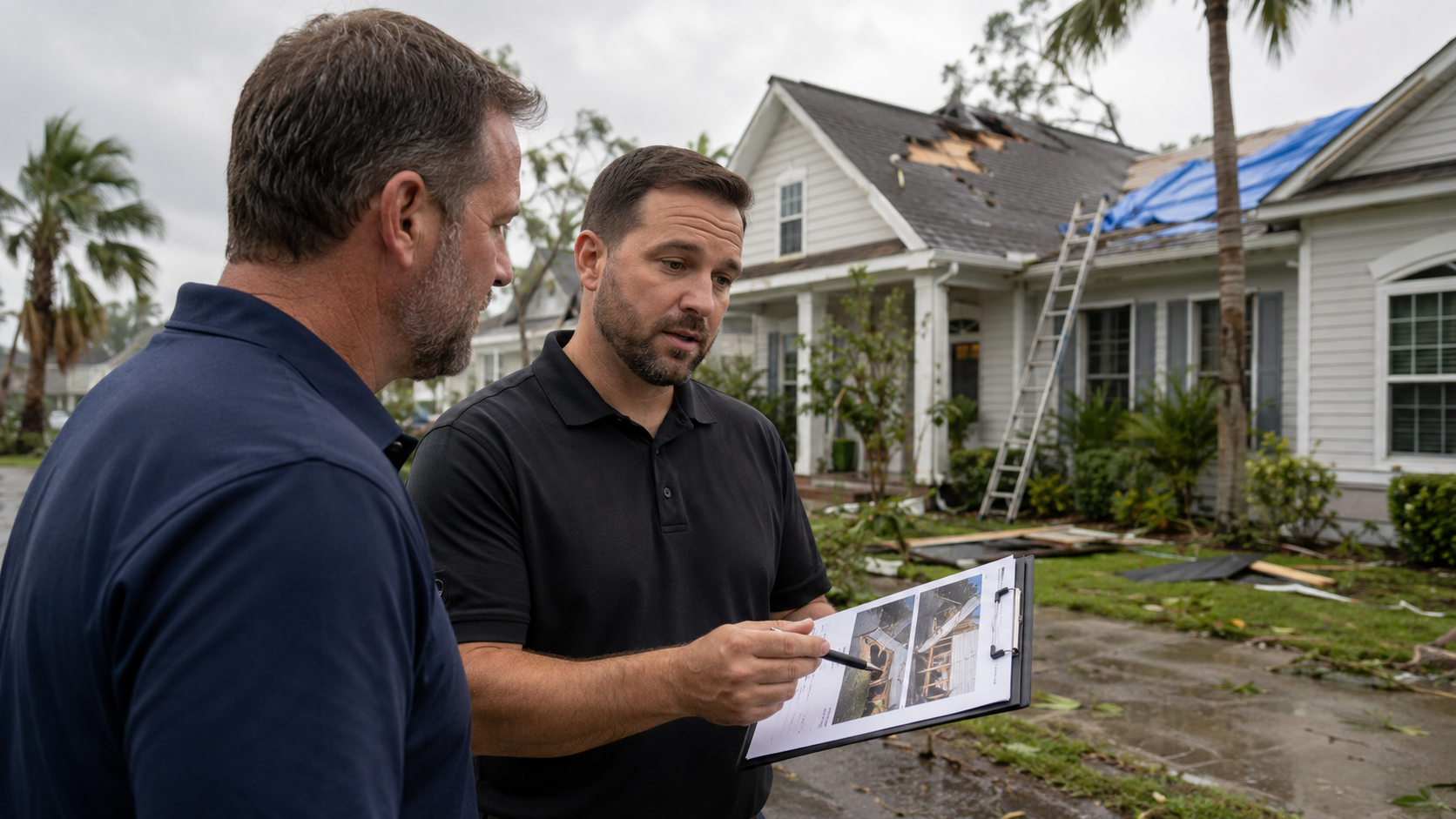
After a major storm hits anywhere from Panama City to Pensacola, the same pattern repeats. Contractors, adjusters, and attorneys flood the affected area within days. Some are legitimate. Others are storm chasers in the most cynical sense – people who follow the disaster map because that’s where the money is.
The reason bad advice spreads so quickly is structural, not personal. When demand spikes suddenly and homeowners are overwhelmed, the information gap becomes enormous. You don’t know what a fair settlement looks like. You don’t know what your policy actually covers. You don’t know how long the process should take. That gap is where bad actors operate – and they know it.
The most confident pitch is the least trustworthy signal. Anyone who walks up to your door three days after a hurricane and tells you they’ll “get you everything you’re owed” is working from a script, not an inspection.
What Does Genuinely Bad Public Adjuster Advice Actually Look Like?
Bad advice isn’t always obvious. It doesn’t always come from someone who seems dishonest. Sometimes it comes from someone who’s enthusiastic, well-reviewed on one platform, and completely wrong for your situation.
Here are the patterns that should make you stop and ask harder questions:
Pressure to sign before the damage is fully documented. A legitimate adjuster wants to inspect thoroughly before committing to a strategy. Someone who pushes a contract in the first 24-48 hours is prioritizing their claim on your settlement, not the quality of your outcome.
Vague or verbal fee arrangements. Florida Statute 626.854 governs public adjuster contracts and requires written disclosure of fees. If someone is explaining their fee verbally and asking you to trust them, that’s not a professional standard – it’s a warning.
Promises of specific outcomes. “We’ll get you $80,000” before anyone has looked at your roof, your contents, or your policy limits isn’t a projection – it’s a sales tactic. No adjuster can know what your claim is worth before the inspection and documentation are complete.
Discouraging you from reading your policy. Your policy is the contract between you and your insurer. Any advisor who tells you not to worry about the fine print – or who can’t explain what it says – isn’t protecting your interests.
The “Advocacy Inversion” Problem: When Your Adjuster Is Working the Wrong Side
Here’s the thing most homeowners don’t realize until it’s too late: a public adjuster who settles fast isn’t necessarily settling well.
There’s a structural incentive problem in parts of the industry. A public adjuster working on contingency – typically a percentage of your settlement – earns more when your settlement is higher. That alignment is usually good for you. But some adjusters work volume, not quality. They’d rather close ten claims quickly at adequate settlements than fight hard for two claims at maximum recovery.
The Advocacy Inversion problem is this: the adjuster appears to be on your side, and technically is, but their behavior is optimized for their own throughput, not your outcome.
Signs of this pattern:
- They respond slowly to your questions but quickly to the insurer’s offers
- They recommend accepting an offer without explaining what was left on the table
- They can’t tell you specifically what line items they disputed and why
A credible public adjuster – the kind Otero Property Adjusting & Appraisals Inc is built around – treats your claim as a negotiation, not a transaction. That means documenting everything, pushing back on underpayments line by line, and keeping you informed at every stage.
What Does Credible Insurance Claims Help Actually Look Like?
Credible guidance has a specific texture. It’s not just “we fight for you.” It’s a process you can follow and verify.
Consider a typical case: a homeowner in the Panhandle files a claim after a hurricane. The insurer sends an adjuster who spends 45 minutes on the property and produces an estimate that covers visible roof damage but misses water intrusion behind the walls, damaged HVAC components, and contents loss. The initial offer is $22,000.
A qualified public adjuster doesn’t just say “that’s too low.” They document what the insurer’s adjuster missed – with photos, contractor assessments, and policy language that supports coverage for each item. They submit a counter-estimate with line-item justification. They know which exclusions are being applied incorrectly and which are legitimate. That specificity is what moves a claim.
The difference between a $22,000 settlement and a $60,000 settlement isn’t luck. It’s documentation and the willingness to push.
The Credibility Scorecard: Evaluating Public Adjuster Advice Before You Commit
The Credibility Scorecard is a five-point evaluation framework for assessing public adjuster advice before signing any agreement. Use it when you’re comparing adjusters or deciding whether to trust the guidance you’ve already received.
| Evaluation Criterion | Green Flag | Red Flag |
| License verification | Licensed through FL DFS, verifiable online | Can’t provide license number |
| Fee disclosure | Written contract, percentage clearly stated | Verbal only, or “we’ll figure it out” |
| Inspection before commitment | Full property inspection before strategy discussion | Settlement promise before any inspection |
| Policy literacy | Explains your coverage and exclusions in plain language | Avoids policy discussion or says “don’t worry about it” |
| Communication standard | Explains what they’re doing and why at each step | Updates only when you ask |
Run every adjuster you’re considering through these five points. A single red flag doesn’t disqualify someone – but two or more should make you pause.
Who Should Be Cautious About Acting on Public Adjuster Advice Alone?
This is worth saying plainly: if your claim involves disputed causation – meaning the insurer is arguing the damage wasn’t caused by the covered event – you may need more than a public adjuster. You may need an attorney alongside your adjuster, particularly if the insurer has issued a denial rather than a low offer.
A public adjuster negotiates the value of an accepted claim. When the insurer disputes coverage entirely, that’s a legal question, not a valuation question.
Otero Property Adjusting & Appraisals Inc works with clients across the full spectrum of claim complexity, and part of what they do is tell you honestly when a situation requires additional expertise. That kind of straight talk is exactly what you should expect from anyone advising you on a claim this significant.
For homeowners in areas like Fort Walton Beach or Destin who’ve received a denial rather than a low offer, the first conversation should clarify which type of problem you’re actually dealing with.
FAQ
How do I verify a public adjuster’s license in Florida?
The Florida Department of Financial Services maintains a public license lookup at their website. Search the adjuster’s name or license number before signing anything. A legitimate adjuster will give you their license number without hesitation – it’s a basic professional credential, not private information.
What percentage do public adjusters typically charge in Florida?
Florida law caps public adjuster fees, and the specific limits depend on whether a state of emergency has been declared for your area. Outside of declared emergencies, fees are typically negotiated as a percentage of the settlement. Get the exact percentage in writing before you commit – verbal agreements aren’t enforceable the same way.
Can I switch public adjusters if I’m not happy with the one I hired?
Yes, but it depends on your contract terms. Most public adjuster contracts include a cancellation window, and Florida law provides some consumer protections around this. Read your contract carefully before signing, and ask specifically about the cancellation terms – that question alone tells you a lot about how an adjuster handles the relationship.
What’s the difference between a public adjuster and the adjuster my insurance company sends?
Your insurer’s adjuster works for the insurance company. Their job is to assess your claim accurately – but their employer’s interest is in settling efficiently, not maximally. A public adjuster works exclusively for you, documents damage from your perspective, and negotiates on your behalf. The same damage, documented by two different adjusters, can produce very different numbers.
Is it too late to hire a public adjuster if I’ve already accepted a partial payment?
Not necessarily. Accepting a partial payment doesn’t always close your claim, depending on how the payment was structured and what language was on the check or release form. If you signed a full and final release, that’s a harder situation. If you didn’t, a public adjuster may still be able to reopen or supplement your claim. Get a professional assessment before assuming you’re out of options.
What should I bring to a first conversation with a public adjuster?
Your insurance policy, any correspondence from your insurer including the initial estimate, photos you’ve taken of the damage, and any contractor estimates you’ve already received. The more documentation you have upfront, the faster an adjuster can assess where your claim stands and what’s worth fighting for.
How long does the claims process take when a public adjuster is involved?
It varies significantly based on claim complexity, insurer responsiveness, and whether the claim goes to appraisal or mediation. Simple claims can resolve in weeks. Complex or disputed claims can take several months. Any adjuster who gives you a guaranteed timeline before seeing your full situation is guessing – and you should know that going in.
If You’ve Already Received an Offer That Feels Wrong, Trust That Instinct
That instinct – the one telling you the number doesn’t add up – is worth acting on. Insurance companies don’t make mistakes in your favor. Low initial offers aren’t errors; they’re positions.
The gap between what you’re offered and what you’re owed doesn’t close on its own. It closes when someone with the right knowledge and the willingness to push hard gets involved.
If you’re a homeowner or property owner anywhere from Miami to Pensacola dealing with hurricane, storm, fire, or water damage – and you’re looking at an offer that doesn’t reflect what you’ve actually lost – contact Otero Property Adjusting & Appraisals Inc for a consultation. No upfront cost. No pressure. Just an honest assessment of where your claim stands and what it’s worth fighting for.
About the Author
Otero Property Adjusting & Appraisals Inc is a Florida-based public adjusting and appraisal firm specializing in helping homeowners and small business owners maximize their insurance claim settlements after hurricanes, storms, fires, and water damage. With more than five years of experience representing clients across the state, they provide hands-on advocacy and detailed claims documentation with no upfront costs. They serve property owners throughout Florida, from the Miami metro area to the Pensacola region.