
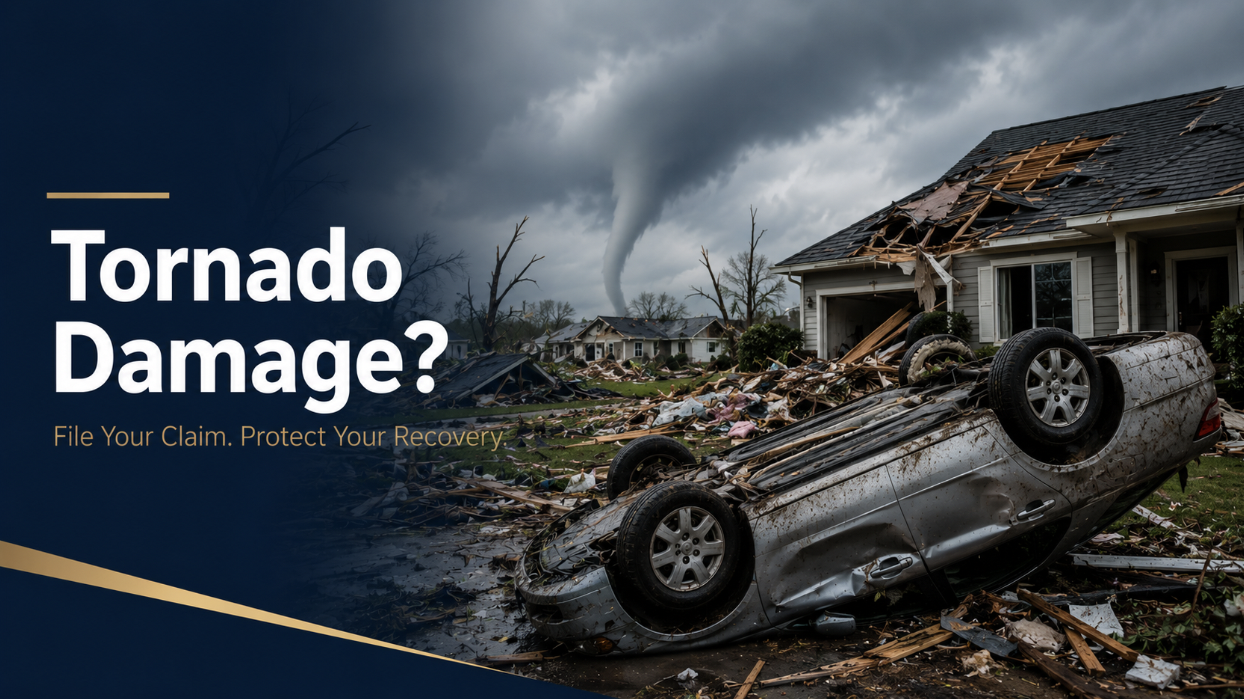
The moment a tornado passes and you walk outside to find your car upside-down in the neighbor’s yard – or worse, simply gone – the shock hits before the questions do. Then the questions hit all at once, and most of them involve money you’re not sure you’re going to get.
What Does a Tornado Insurance Claim Actually Cover?
A tornado insurance claim is the formal process of notifying your insurer, documenting all damage, and negotiating a settlement for losses caused by a tornado event. For vehicles, comprehensive auto coverage – not collision – pays for tornado damage. For your home and structures, your homeowners policy applies. Filing both simultaneously, with thorough documentation, is how you fully document the claim. Most initial offers undervalue the full scope of damage.
Key Takeaways
• Tornado vehicle damage falls under comprehensive auto coverage, not collision – a distinction that changes your deductible and claim path entirely.
• Document everything before cleanup begins: photos, video, written inventory, and timestamps.
• Your homeowners policy and auto policy are separate claims filed with separate adjusters – coordinate them carefully to avoid gaps.
• Insurance companies send their own adjusters to protect their own interests. A licensed public adjuster works for you.
Why Does the First Insurance Offer Almost Never Reflect the Real Damage?
Here is the contrarian claim worth sitting with: the insurance company’s adjuster is not your adjuster.
They work for the insurer. Their job is to assess damage efficiently and close claims within budget. That is not a conspiracy – it is just the structure of the system. The insurer’s adjuster may be thorough and professional, and the initial offer may still be low. Not because of bad faith, but because a single walkthrough on a tight timeline rarely captures the full picture of tornado damage – hidden structural stress, secondary water intrusion, contents buried under debris, or code-upgrade requirements that Florida law mandates on repairs.
The mechanism matters here. Low initial offers persist not because insurers are universally dishonest, but because damage assessment is genuinely difficult, and the default incentive structure favors efficiency over completeness. A public adjuster’s job is to slow that process down, look harder, and document what the first pass missed.
The insurance company’s adjuster closes claims. A public adjuster opens them back up – and that difference is where most of the money lives.
What Are the Immediate Steps After Tornado Damage?
Move through these in order. Do not skip step one to get to the phone calls faster.
1. Confirm safety first.
Do not re-enter a structurally compromised building. Florida tornadoes frequently cause roof decking separation and wall racking that isn’t visible from the outside. If there’s any doubt, wait for a professional assessment.
2. Document before you touch anything.
Walk the entire property with your phone camera running. Capture your vehicle from every angle, including underneath if accessible. Photograph the structure, every room, the yard, fencing, outbuildings. Timestamp matters – do this before any cleanup or temporary repairs.
3. Prevent further damage – but document that too.
Florida homeowners have a legal duty to mitigate additional damage after a loss event. Cover broken windows, tarp roof damage, move salvageable contents to dry storage. Keep every receipt. Photograph mitigation work as you do it. These costs are typically reimbursable under your policy.
4. File your notice of loss promptly.
Contact your homeowners insurer and your auto insurer separately. Each policy requires its own claim. Florida statutes set specific deadlines for reporting and for insurer response – missing them can complicate your claim.
5. Request a copy of your full policy.
Most people have not read their policy since the day they signed it. You need the declarations page, the coverage sections, and the exclusions. Know what you have before anyone tells you the benefits available under your policy.
How Do You Document Tornado Damage the Right Way?
Documentation is not just photos. It is a structured record that tells a story an adjuster – and if necessary, an arbitrator – can follow without your narration.
The Four-Layer Documentation Method is the framework practitioners at Otero Property Adjusting & Appraisals use when building a claim file:
• Layer 1 – Visual: Photos and video of all damage, taken from wide-angle to close-up, before any cleanup.
• Layer 2 – Inventory: A written list of every damaged or destroyed item with approximate age, brand, and replacement cost. For vehicles, include the VIN and current market value.
• Layer 3 – Third-Party Confirmation: Contractor estimates, mechanic assessments, and weather verification reports (the National Weather Service publishes tornado path data that can corroborate your claim timeline).
• Layer 4 – Cost Substantiation: Receipts, invoices, and comparable market pricing for everything you’re claiming.
An insurance company can dispute a photo. It is much harder to dispute four layers of coordinated evidence.
A homeowner in the Pensacola area filed a tornado claim after losing a detached garage and two vehicles. The initial offer covered one vehicle at actual cash value and excluded the garage structure entirely, citing a coverage ambiguity. After engaging Otero Property Adjusting & Appraisals, a full re-documentation of the site – including a structural engineer’s note on the garage foundation – resulted in a settlement that included both the structure and both vehicles, significantly above the original figure.
What Is the Difference Between Filing on Your Own Versus Using a Public Adjuster?
| Factor | Filing on Your Own | Using a Public Adjuster |
| Who represents you | Nobody | Licensed advocate working solely for you |
| Damage assessment | Insurer’s adjuster | Independent, detailed re-inspection |
| Policy interpretation | You interpret it | Professional reads coverage on your behalf |
| Negotiation | You negotiate | Experienced negotiator handles it |
| Typical outcome | Initial offer accepted | Disputed, re-documented, often increased |
| Time investment | High – you manage all communication | Low – adjuster manages the process |
| Best for | Small, clear-cut claims with no dispute | Complex damage, disputed offers, multiple policies |
The incentive alignment is direct.
Most people don’t realize they can dispute an insurance offer after they’ve already received it. The claim isn’t closed until you sign a release – and that moment is later than most policyholders think.
What Happens After You File – and How Long Does It Actually Take?
This is the follow-up question most people ask after they understand the filing process. The honest answer: it varies, and anyone who gives you a single timeline without knowing your policy and insurer is guessing.
Florida statutes require insurers to acknowledge a claim within 14 days and make a coverage decision within 90 days of receiving proof of loss. That is the legal framework. The practical reality is that tornado events affecting multiple properties simultaneously – common in Florida’s storm corridors from Miami to Pensacola – create adjuster backlogs that stretch timelines.
A straightforward claim with clear documentation and no coverage disputes can resolve in 30 to 60 days. A disputed claim involving structural damage, multiple policies, or a denied line item can run six months or longer. Engaging a public adjuster early compresses this timeline because the documentation is complete from the start – there are fewer back-and-forth requests for additional information. If you want to understand what are the responsibilities of a claims adjuster working on the insurer’s side, that context helps you anticipate where gaps in a single-pass inspection tend to appear.
Who Is This Approach NOT Right For?
Honest answer: if a tornado knocked over a single fence panel and your insurer’s offer covers the replacement cost, hiring a public adjuster is probably unnecessary overhead. Small, uncontested claims with straightforward damage and cooperative insurers don’t require advocacy.
Public adjusting earns its value when:
• The damage is extensive or structurally complex
• The initial offer feels significantly low
• Multiple structures or vehicles are involved
• The insurer has denied a line item or cited an exclusion you don’t understand
• You simply don’t have the time or bandwidth to manage a drawn-out claims process
Otero Property Adjusting & Appraisals offers a free consultation – which means you can find out whether your situation warrants representation before committing to anything. Understanding which of the following is a reason a claim would be denied can help you identify the specific language your insurer may be using to reduce or reject a line item before you accept any offer.
Frequently Asked Questions
Does my homeowners insurance cover my car if a tornado destroys it?
No. Your homeowners policy covers the structure and its contents – your vehicle is not considered personal property under a homeowners policy. Tornado damage to a vehicle is covered under the comprehensive portion of your auto insurance policy, not collision. You’ll file two separate claims if both your home and car were damaged.
What if my car was inside my garage when the tornado hit – does that change anything?
The vehicle is still covered under your auto policy’s comprehensive coverage, not your homeowners policy. However, the garage structure itself is covered under homeowners. You’ll document and file both separately, and a public adjuster can help coordinate the two claims to make sure nothing falls through the gap between policies.
Can I file a tornado insurance claim if I already started cleanup?
Yes, but document everything you can right now before going further. Courts and insurers accept after-the-fact documentation, but contemporaneous photos and records carry more weight. If cleanup has already begun, gather whatever evidence remains – contractor invoices, debris photos, neighbor accounts – and build the strongest file possible from where you are.
What does a public adjuster actually do that I can’t do myself?
A public adjuster reads your policy the way an attorney reads a contract – looking for coverage you may not know you have, exclusions that may not legally apply, and valuation methods that favor the insurer over you. They also conduct an independent damage inspection, build a documented claim file, and negotiate directly with the insurer. Most policyholders don’t have the time, training, or leverage to do all three effectively under pressure.
Is there a deadline to file a tornado insurance claim in Florida?
Florida law generally requires property insurance claims to be reported within a reasonable time, and many policies specify a one-year window from the date of loss for initial filing. Supplemental claims for discovered damage may have different windows. Do not wait – contact your insurer and a public adjuster promptly after the event to protect your rights.
What if the insurance company already sent me a check – can I still dispute the amount?
In most cases, yes – as long as you have not signed a release or a proof of loss that closes the claim. Accepting a check for an initial payment does not automatically close your claim. Otero Property Adjusting & Appraisals has helped clients reopen and supplement claims after receiving initial payments that did not reflect the full scope of damage.
You’ve Read This Far Because the Number on That Check Doesn’t Feel Right
If you’re sitting with an insurance offer that doesn’t come close to covering what you lost, that instinct is worth acting on. Knowing how to respond to a low settlement offer before you pick up the phone can change the outcome of that conversation entirely.
Call or contact Otero Property Adjusting & Appraisals today for a free, no-obligation consultation. The team serves homeowners and property owners across Florida – from Miami to Pensacola – and they will review your claim, your policy, and your options at no cost to you. You don’t have to accept the first offer. You don’t have to navigate this alone.
Contact Otero Property Adjusting & Appraisals – get your claim reviewed before you sign anything.
References
National Weather Service (weather.gov) – Tornado event records and storm path data used to corroborate insurance claim timelines.
Florida Department of Financial Services (myfloridacfo.com) – Florida insurance claim filing requirements, policyholder rights, and insurer response deadlines under Florida statutes.
Florida Office of Insurance Regulation (floir.com) – Regulatory framework governing public adjusters, insurer obligations, and property insurance standards in Florida.