
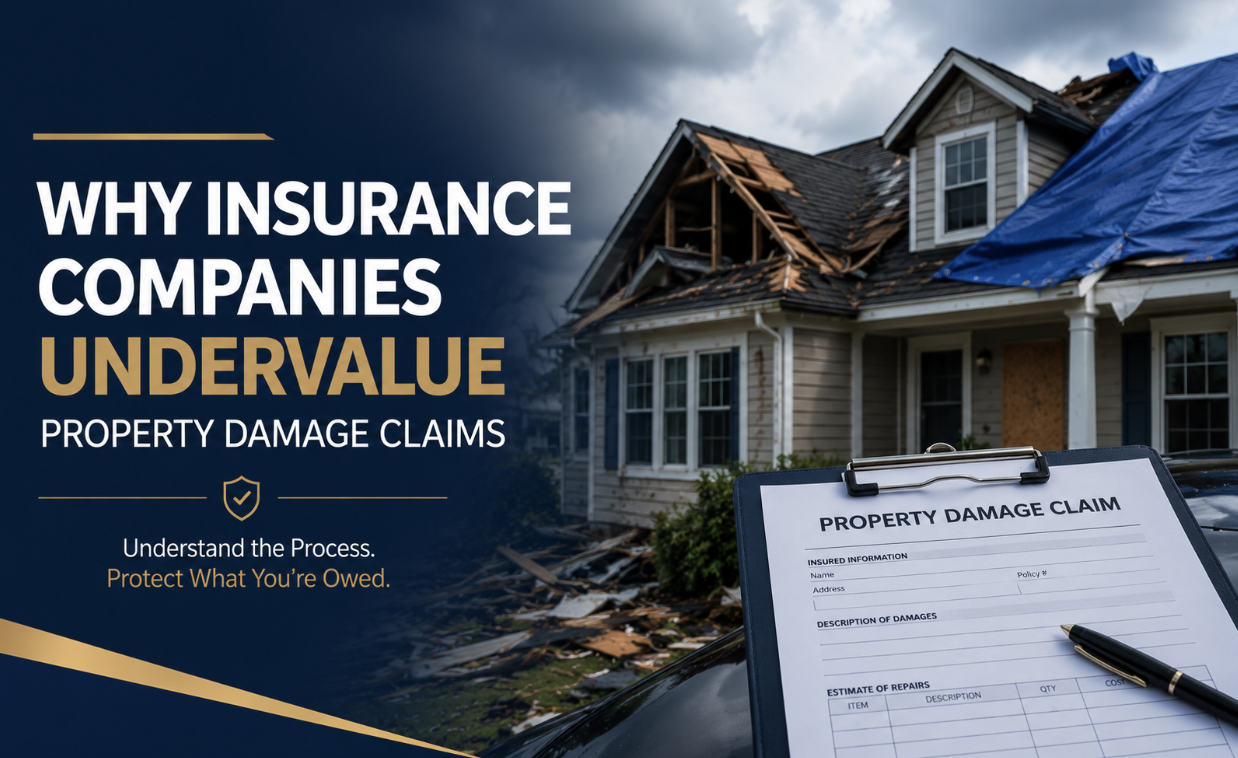
The damage is real. The policy is paid up. And somehow, the number the insurance company hands you feels like they assessed a different property entirely. That gap – between the benefits available under your policy and what you’re offered – is not an accident.
What You Need to Know First
Insurance companies routinely issue initial settlement offers that fall short of what a policy actually covers. This happens because adjusters working for the insurer are trained to document visible damage, apply depreciation aggressively, and interpret policy language in the insurer’s favor. Policyholders who accept the first offer without independent review leave significant recovery on the table – sometimes tens of thousands of dollars.
Key Takeaways
• Insurance adjusters work for the insurance company, not for you – their job is to settle claims efficiently, not maximally.
• Policy language around exclusions, depreciation, and “actual cash value” vs. “replacement cost value” directly controls how much you receive.
• A detailed, independent damage assessment is the single most effective tool for challenging an underpaid claim.
• Florida policyholders have the right to invoke the appraisal process if they dispute a settlement – most never know this option exists.
Why Does the Insurance Company’s Number Feel So Wrong?
The short answer: because their adjuster and your interests are structurally opposed.
The insurance company’s adjuster – called a “staff adjuster” or “independent adjuster” – is hired and paid by the insurer. Their job is to document your claim accurately, yes, but also to apply policy terms in ways that minimize payout. That is not cynicism. That is the business model.
The most common reasons a claim gets undervalued:
• Incomplete damage documentation. An adjuster who spends two hours on a storm-damaged roof is not going to find the secondary water intrusion behind your walls, the compromised subfloor in the kitchen, or the HVAC damage from debris infiltration. What isn’t documented doesn’t get paid.
• Aggressive depreciation. Insurers apply depreciation to reduce what they owe under “actual cash value” policies. A 15-year-old roof may be depreciated so heavily the payout barely covers labor, let alone materials.
• Exclusion application. Policies contain exclusions – for mold, for “earth movement,” for certain water damage categories – and adjusters are trained to identify language that shifts damage into excluded categories.
• Scope of loss disputes. The insurer may agree damage exists but dispute whether it’s covered under your specific policy language, or argue the damage pre-existed the event.
The insurance company isn’t necessarily lying to you. They’re just using the same document you signed – and they understand it far better than you do.
What’s Really Driving the Underpayment Problem?
The root cause isn’t bad faith in every case. It’s information asymmetry.
Insurance policies are dense legal documents. The Florida Department of Financial Services notes that standard homeowners policies can run 40 to 60 pages of coverage language, exclusions, conditions, and endorsements. Most policyholders have never read them. The insurer’s adjuster has processed hundreds of similar claims under that exact policy form.
That knowledge gap is where claims get lost.
There’s also a structural incentive problem. Staff adjusters carry high caseloads – especially after a major Florida hurricane event, when a single storm can generate thousands of simultaneous claims across the panhandle or South Florida. Speed is rewarded. Thoroughness is not always.
This is the contrarian claim worth sitting with: Accepting the first offer isn’t just leaving money behind – it’s permanently waiving your right to more. In Florida, once you sign a release and cash a final settlement check, the claim is closed. There is no “I changed my mind” option. The stakes of the first offer are higher than most homeowners realize. If you’ve already received a low offer, understanding how to respond to a low settlement offer can make a critical difference before you sign anything.
What Does a Detailed Damage Assessment Actually Change?
Everything. And here’s the mechanism, not just the outcome.
A thorough independent damage assessment works because it creates a documented record that the insurer must respond to. It shifts the negotiation from “our adjuster said X” to “here is a line-by-line scope of loss with photographs, measurements, and contractor estimates.” The insurer can no longer rely on what wasn’t found – they have to address what is documented.
The Otero Claim Documentation Method – the approach used by Otero Property Adjusting & Appraisals in every client engagement – follows a three-phase structure:
1. Full-property physical inspection, including interior, exterior, roof system, mechanical systems, and any secondary structures. Not a visual walk-through. A documented inspection.
2. Policy cross-reference, matching each documented damage item against the specific coverage language in the client’s policy – including endorsements and riders that are often overlooked.
3. Scope of loss preparation, building a claim package that mirrors the format insurers use internally – making it harder to dispute or dismiss.
This is not a shortcut process. It takes time. But practitioners using this approach consistently report settlements that exceed initial offers by meaningful margins.
Handling a Claim Yourself vs. Working With a Public Adjuster
A public adjuster is a licensed professional who works exclusively for the policyholder – not the insurance company – to document, prepare, and negotiate property damage claims.
| Factor | Handling It Yourself | Working With a Public Adjuster |
| Knowledge of policy language | Limited for most homeowners | Deep familiarity with policy forms |
| Damage documentation | Visual, surface-level | Systematic, full-property inspection |
| Negotiation leverage | Low – insurer controls the process | High – documented scope creates pressure |
| Time investment | Significant – your time, your stress | Managed by the adjuster |
| Final outcome | Often first offer accepted | Typically higher than initial offer |
Who This Approach Doesn’t Serve
Public adjusting is not the right fit for every situation.
If your insurer has already issued a fair, well-documented settlement that aligns with independent contractor estimates, there may be nothing meaningful to negotiate.
Public adjusters also cannot help you after you’ve signed a final release and accepted a settlement as “full and final.” That window matters. If you’re still in the claims process – or if your claim has been denied – there is still time.
The question isn’t whether you can handle a claim yourself. The question is whether you know enough about your policy to know what you’re not asking for.
How Public Adjusters Actually Advocate for You
Advocacy is not just negotiation. It’s preparation.
When Otero Property Adjusting & Appraisals takes on a claim, the work begins before a single conversation with the insurer. The claim package – the documented scope, the policy analysis, the supporting evidence – is built first. By the time the insurer’s adjuster is engaged, there is a paper record that demands a response.
Florida law also gives policyholders the right to invoke the appraisal clause – a formal dispute resolution process built into most homeowners policies. If negotiations stall, this clause allows both sides to appoint appraisers who work toward a binding resolution without litigation. Most policyholders never know it exists. Public adjusters use it routinely. Understanding the responsibilities of a claims adjuster on the insurer’s side helps explain why having your own representation levels the playing field.
Most policyholders don’t lose their claims in court. They lose them in the first 30 days – before they know the benefits available under their policy.
Frequently Asked Questions
How do I know if my insurance settlement offer is too low?
If the offer doesn’t cover the full cost of repairs from two or three independent contractor estimates, it’s likely underpaid. The clearest signal is a gap between what a licensed contractor says the repair costs and what the insurer is willing to pay – that gap is where a public adjuster works.
What does a public adjuster actually do that I can’t do myself?
A public adjuster reads your policy the way the insurer reads it – looking for every coverage that applies, not just the obvious ones. They document damage systematically, prepare a formal scope of loss, and negotiate from a position of documented evidence rather than frustration. Most homeowners don’t have the training or the time to do this at the level that moves an insurer.
Can a public adjuster help if my claim was already denied?
Yes, in many cases. A denial is not always final. Public adjusters can review the denial letter, identify whether the insurer applied policy language correctly, and help you file a supplemental claim or request reconsideration with proper documentation. The earlier you engage after a denial, the more options remain available.
What if I’ve already accepted a partial payment – is it too late?
A partial payment is not always a final settlement. If you have not signed a release or accepted payment marked “full and final,” the claim may still be open. Review any documents you’ve signed carefully, and contact a public adjuster to assess where you stand before assuming the claim is closed.
Does hiring a public adjuster make the insurance company treat me worse?
No – and this is a common fear worth addressing directly. Insurers deal with public adjusters routinely. A well-documented claim submitted by a licensed public adjuster is harder to dismiss, not easier. The presence of professional representation typically accelerates resolution because it signals the insurer that the claim will be contested if underpaid.
How long does the claims process take when working with a public adjuster?
It varies by claim complexity, insurer responsiveness, and whether the appraisal process is invoked.Complex hurricane or fire claims with disputed scope may take four to six months. What a public adjuster controls is the quality of documentation and the consistency of follow-through – not the insurer’s timeline.
If You’re Reading This After Getting an Offer That Doesn’t Feel Right
That instinct is worth acting on – before you sign anything.
Otero Property Adjusting & Appraisals offers claim reviews for Florida homeowners and business owners from Miami to Pensacola. If the offer you received is fair, we’ll tell you that too. You can also explore our blogs for additional guidance on navigating the claims process in Florida.
Call or contact us today to have your claim reviewed by a licensed Florida public adjuster who works for you – not the insurance company.
Contact Otero Property Adjusting & Appraisals for a claim review today
References
Florida Department of Financial Services – Consumer guide to homeowners insurance, including policy structure, exclusions, and the appraisal clause process.