
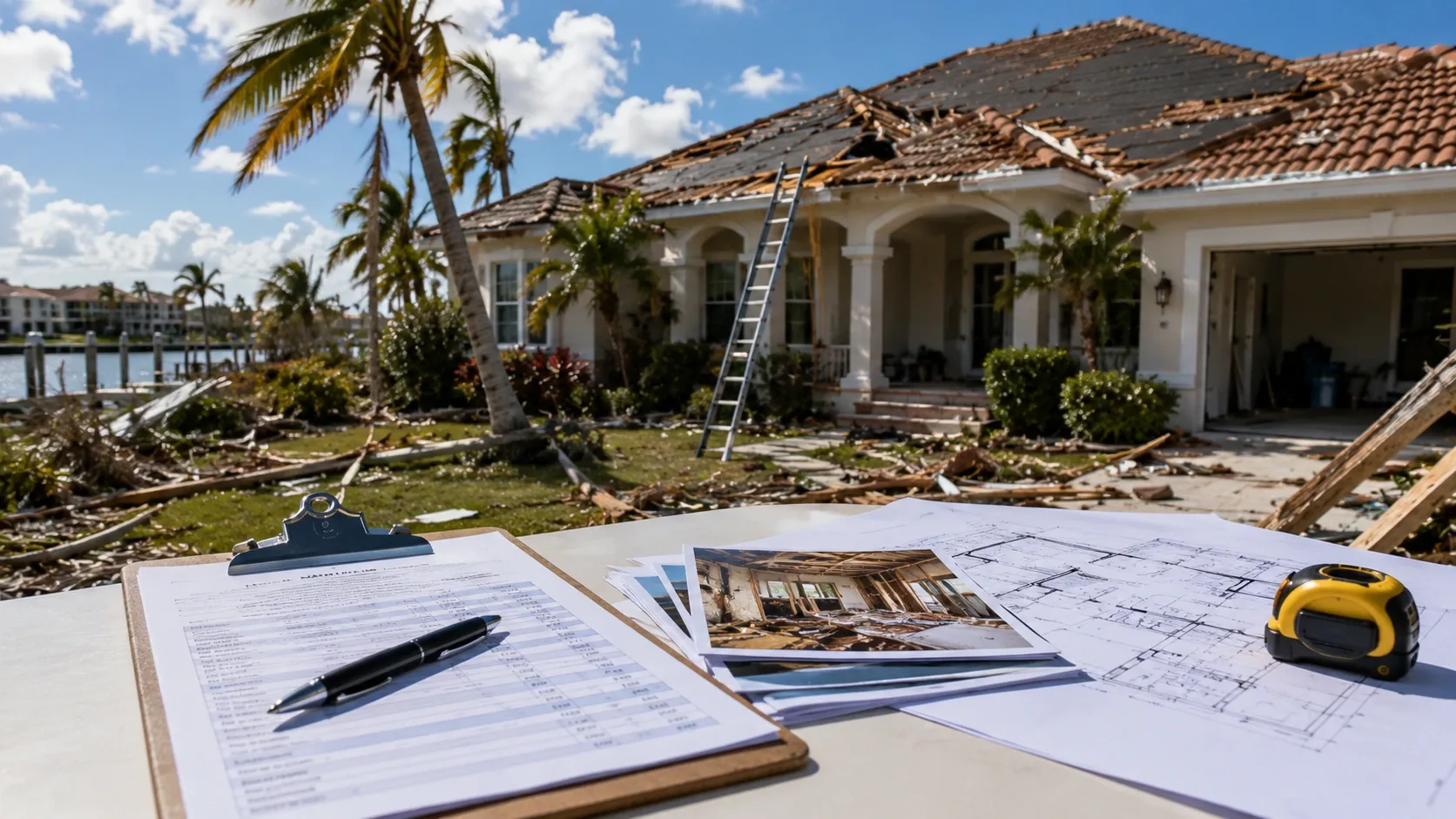
When an insurance company hands you a settlement number, that figure reflects their adjuster’s inspection, their scope, and their goal of closing the claim efficiently. A public adjuster works for you instead, reviewing the same damage with the opposite mandate: document everything, defend the full scope, and push the insurer to pay what the policy actually covers.
Key Takeaways
- A public adjuster represents the policyholder, not the insurance company, and works to close the gap between the initial offer and the actual cost of restoring your property.
- The insurance appraisal process is a formal, binding dispute resolution path built into most Florida policies specifically for valuation disagreements.
- Strong outcomes depend on documentation quality before appraisal is invoked, not during it.
- Otero Property Adjusting & Appraisals serves homeowners and business owners from Miami to Pensacola with no upfront costs and a contingency-fee model.
- Waiting past Florida’s filing deadlines is the single most expensive decision you can make after receiving a low offer.
What Does a Public Adjuster Actually Do for a Florida Property Owner?
The distinction between a public adjuster and an insurance company adjuster sounds straightforward. In practice, it changes everything about how your claim gets handled.
The insurer’s adjuster documents damage on behalf of the carrier. Their job is to establish what the policy covers at the lowest defensible number, and they are very good at it. Their entire career is built around exactly this process. If you’re negotiating against that expertise without professional representation, you’re starting the conversation at a disadvantage.
A public adjuster levels that field. Otero Property Adjusting & Appraisals begins with a no-cost consultation to review your policy and your existing claim. From there, their team performs a detailed inspection, documents all visible damage, prepares repair estimates, and takes over direct communication with the insurance company. They negotiate on your behalf until the claim is resolved. You don’t pay upfront. Their fee comes from the increased settlement they recover for you, which means their incentive and yours are identical from day one.
That structure matters. When the adjuster who’s fighting for you only gets paid if you get a better result, you’re not paying for effort. You’re paying for outcomes.
How Does the Appraisal Process Actually Work?
The insurance appraisal process is a formal dispute resolution mechanism written directly into most Florida homeowner and commercial property policies. It exists specifically for situations where both parties agree that a covered loss occurred, but disagree on what it’s worth. This is different from a denied claim. Appraisal resolves valuation disputes, not coverage disputes.
Here’s how the process works:
- Either party invokes the appraisal clause in writing.
- Each side selects a competent, independent appraiser.
- The two appraisers attempt to reach a mutual agreement on the loss amount.
- If they can’t agree, they jointly select a neutral umpire.
- Any decision agreed to by two of the three parties (your appraiser, the insurer’s appraiser, or the umpire) becomes binding.
The umpire is the swing vote. That makes the quality of your appraiser, and the strength of the documentation they present, the single most important variable in the process. An appraiser who walks into the umpire review with complete photographs, detailed repair estimates, and a clear narrative of how the insurer’s scope falls short is in a fundamentally different position than one who doesn’t.
This is why the documentation phase is where the real work happens. By the time an umpire is reviewing two competing positions, the outcome has often already been shaped by what was prepared weeks earlier.
To understand how the claim process works from first notice through resolution, it helps to know where the appraisal clause fits before you decide whether to invoke it or continue negotiating directly.
What Drives Strong Outcomes Versus Weak Ones?
The gap between what your insurance company offers and what your claim is actually worth isn’t a clerical error. It’s the predictable result of a process designed to move quickly and pay out as little as possible. But not every claim that goes to appraisal produces the same result. What you do before appraisal is invoked is what separates a strong outcome from a disappointing one.
Strong results typically come from:
- Thorough documentation before the appraisal process is formally invoked.
- A clear paper trail showing what the insurer originally offered and exactly why that number doesn’t cover actual repair scope.
- An experienced appraiser who can defend methodology and line-item estimates under direct scrutiny.
- Moving before the claim goes stale, because documentation degrades and deadlines approach.
Weaker results tend to trace back to:
- Incomplete or missing documentation of original damage, especially when repairs were started before the scope was fully recorded.
- Delayed action after the initial offer (knowing the time limit to sue in Florida isn’t optional information when a disputed claim is sitting on your table).
- Policyholders who’ve already made repairs without photographing the pre-repair condition.
The mechanism behind strong outcomes isn’t mysterious. It’s a preparation meeting process.
What’s an Honest Timeline for Appraisal and Umpire Services?
Most policyholders want a specific answer. The honest range is 30 to 90 days from the formal appraisal demand to a binding decision. Complex commercial or multi-structure claims can run longer.
What extends the timeline:
- Insurer delays in selecting their appraiser (this happens, and it’s a known pressure tactic).
- Difficulty agreeing on a neutral umpire when both sides have strong positions.
- Scope disputes requiring additional inspections of specific systems or structural damage.
- A backlog of active claims across Florida following a major storm event.
What compresses it:
- Documentation already complete before appraisal is formally invoked.
- An experienced public adjuster who knows exactly how to keep the process from stalling.
- Clear policy language that leaves little room for procedural delay tactics.
Every week without resolution is a week you’re potentially absorbing costs for temporary repairs, living in a damaged property, or watching secondary damage develop that wasn’t in the original scope. Water damage compounds in ways that aren’t always visible until well after the initial event, and a slow claim doesn’t stop the deterioration from continuing.
The Assumption Worth Challenging: Accepting the First Offer Feels Safe
Most policyholders treat the initial insurance offer as a number they can at least live with. That assumption is worth examining.
The first offer is built on the insurer’s adjuster’s inspection. That adjuster works for the insurance company. Their estimate reflects what the policy covers at a number the company can defend in writing, not necessarily what it costs to restore your property to its pre-loss condition. Accepting without pushback doesn’t protect you from conflict. It just means you absorb the shortfall out of pocket.
There’s a second thing worth knowing: invoking appraisal doesn’t damage your standing with your insurer or put your policy at risk. It’s a contractual right. Using it replaces informal back-and-forth with a structured, documented process that produces a binding result. What puts your position at risk is waiting until the filing window has closed.
If you’re not certain what the insurance company won’t tell you going into a claim negotiation, that gap in preparation costs real money.
How Outcomes Compare: With Representation Versus Without
| Scenario | What to Expect |
|---|---|
| Accepting the initial offer without review | Settlement reflects the insurer’s scope, which is often incomplete on covered items |
| Negotiating directly without documentation | Hard to counter a professional estimate without independent repair scope and records |
| Hiring a public adjuster after receiving the initial offer | Full re-inspection, documented scope, formal negotiation, no upfront cost |
| Invoking appraisal with experienced representation | Binding resolution based on documented evidence, not insurer preference alone |
| Waiting past Florida’s claim filing deadlines | Potential loss of the right to dispute or pursue additional recovery |
Otero Property Adjusting & Appraisals works on contingency. That means no upfront fee, and their compensation comes from the increased settlement they recover. If they don’t recover more than the original offer, you don’t owe a fee for the work.
When This Process Isn’t the Right Fit
Straight talk: appraisal and public adjuster representation isn’t the right tool for every situation.
If your claim was denied on a coverage question entirely (the insurer says the damage simply isn’t covered, not just undervalued), appraisal doesn’t resolve that. Coverage disputes require a different legal approach.
If you’ve already accepted a settlement and signed a full release, that typically closes the claim. There are narrow exceptions, but the window is tight.
For claims involving fire damage and how your policy actually responds to it, or smoke damage that isn’t immediately visible, the complexity almost always justifies professional review. Damage categories that appear straightforward on the surface are often the ones with the most underdocumented scope and the largest gap between the initial offer and actual repair cost.
The free consultation is specifically for situations where you’re not sure whether the gap is large enough to make representation worthwhile. Otero will tell you honestly before you commit to anything.
Frequently Asked Questions
How do I know if my insurance settlement offer is too low?
If the offer doesn’t cover the full cost to restore your property to its pre-loss condition, it’s too low. The most reliable way to find out is to get an independent repair estimate and compare it to what the insurer is offering. A public adjuster can do that comparison for you at no upfront cost during a free consultation.
What does it cost to hire a public adjuster in Florida?
Otero Property Adjusting & Appraisals works on a contingency basis. You pay nothing upfront. Their fee comes out of the settlement they recover on your behalf. If they don’t recover more than the original offer, there’s no fee for the work.
Can I invoke the appraisal process after I’ve already been negotiating with my insurer?
Yes, in most cases. The appraisal clause in your policy can typically be invoked at any point while the claim is still open, as long as you haven’t signed a full release. The specific language in your policy governs the timing, which is one reason having a public adjuster review that language early matters so much.
What’s the difference between an appraisal and a lawsuit?
Appraisal is a contractual dispute process built into your policy for valuation disagreements. It’s faster, less expensive, and doesn’t require an attorney. A lawsuit is a separate legal action, typically used when coverage is denied or when bad faith handling is involved. They’re different tools for different problems, and knowing which applies to your situation is part of what the initial consultation clarifies.
Does using a public adjuster put my policy renewal at risk?
Florida law prohibits insurers from non-renewing a policy solely because a policyholder filed a claim. Using a public adjuster or invoking the appraisal process is a contractual right, not a policy violation. Your coverage isn’t jeopardized by exercising the rights your policy already gives you.
How long does the umpire process take once it’s started?
Once an umpire is selected and both appraisers have submitted their positions, a decision typically comes within 30 to 60 days. The longer delays usually happen earlier in the process, during appraiser selection or umpire agreement. Experienced representation keeps that process from stalling at each stage.
What types of property damage does this process apply to?
Appraisal and public adjuster services apply to virtually any covered property damage, including hurricane and wind damage, water intrusion, fire, smoke, and storm-related losses. If your policy covers the event and the insurer’s number doesn’t match the actual repair cost, the appraisal process exists specifically to resolve that gap. You can also review what damages you can claim under a standard Florida homeowners policy to understand the full scope of what’s recoverable.
If you’re in Miami, Pensacola, or anywhere along Florida’s Gulf Coast and you’re sitting on a settlement offer that doesn’t feel right, contact Otero Property Adjusting & Appraisals for a no-cost consultation. With 7-plus years serving Florida policyholders, five-star reviews, and a contingency-fee model, the conversation costs you nothing. Call 850-285-0405 before the filing window closes.