
Is The Employer Responsible For Mold Exposure? Expert Answers for Florida Workers and Property Claims
Mold has a talent for arriving like an uninvited cousin: quietly, damply, and with a smell that suggests the basement has given up on life. If you came here asking Is the employer responsible for mold exposure?, the short answer is often yes, at least when the employer knew or should have known about the hazard and failed to act. Is the employer responsible for mold exposure? That question sits at the center of workplace safety, workers’ rights, building maintenance, and, in many Florida cases, insurance claims tied to water damage.
Mold exposure can trigger coughing, wheezing, eye irritation, skin rashes, and asthma flare-ups. The CDC states that damp buildings are linked with respiratory symptoms and asthma. The EPA also warns that moisture control is the key to mold control. Based on our research, employers ignore leaks at their peril, especially in Florida, where humidity can hover above 70% for long stretches of the year. In 2026, that still has not changed, and neither has the law’s general expectation that a workplace should not double as a mushroom farm.
You also need to know where OSHA fits in, what evidence matters, what insurance may cover, and when a public adjuster can help. We analyzed the legal and practical side of these claims with a Florida lens, because a mold complaint in Pensacola does not play out quite like one in Phoenix. Water intrusion, roof leaks, HVAC failures, and delayed repairs can turn a small stain into a large claim. If that claim touches property damage, Otero Property Adjusting & Appraisals can help you sort the paper trail before it sorts you.
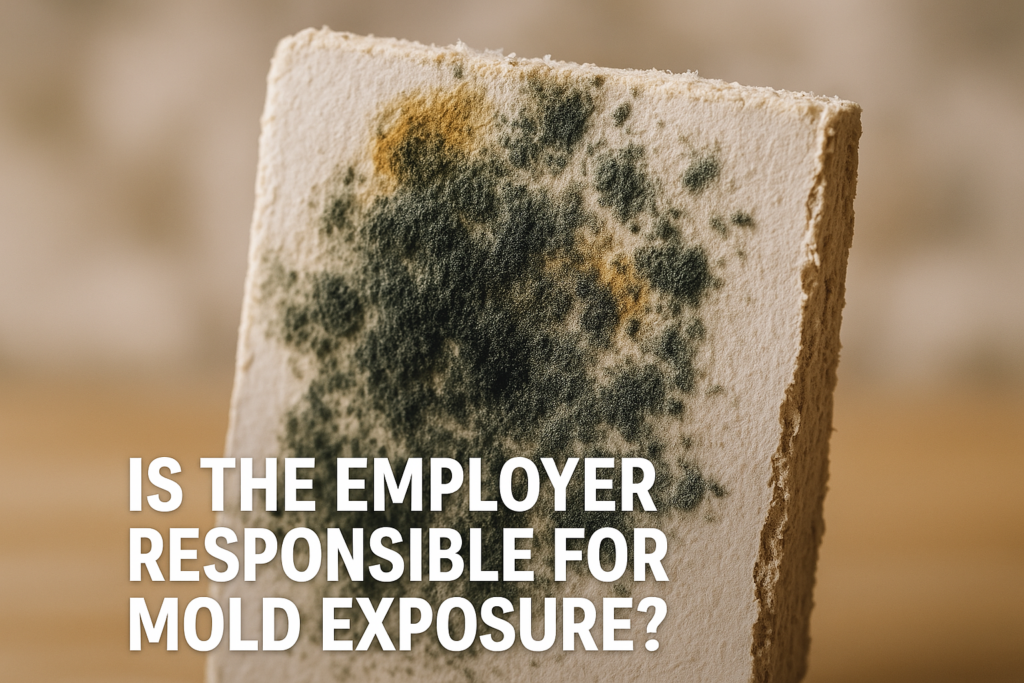

What is Mold Exposure?
Mold exposure happens when you breathe in, touch, or otherwise come into contact with mold spores, mold fragments, or the byproducts of mold growth. Workplaces see mold in drywall, ceiling tiles, carpet backing, insulation, HVAC systems, break rooms, file storage areas, and around windows that sweat like a glass of sweet tea in July. Common indoor molds include Cladosporium, Penicillium, Aspergillus, and Stachybotrys chartarum, the one people usually call “black mold,” often with the same tone used for tax audits.
The health effects vary. According to the CDC/NIOSH, people in damp buildings report respiratory symptoms, infections, worsening asthma, and hypersensitivity reactions. The National Institute of Environmental Health Sciences notes that molds produce allergens and irritants, and for some people that is enough to turn a regular workday into an endurance event. Is the employer responsible for mold exposure? Often that depends on whether the employer failed to fix leaks, ignored complaints, or allowed cleanup to be done poorly. Is the employer responsible for mold exposure? If the building owner and employer are different parties, there can be shared blame, which is where records matter.
Prolonged exposure raises the stakes. A Institute of Medicine review, still cited by public health agencies, found sufficient evidence linking damp indoor environments with upper respiratory symptoms, coughing, and wheezing in otherwise healthy people. Studies summarized by the World Health Organization found occupants of damp buildings had increases of roughly 30% to 50% in respiratory and asthma-related outcomes. In our experience, the practical point is simple: if symptoms improve on weekends and flare up by Tuesday afternoon in the office, that pattern deserves attention, documentation, and often testing.
Legal Responsibilities of Employers Regarding Mold Exposure: Is the employer responsible for mold exposure?
Federal law does not give mold its own neat little rulebook, which seems rude, considering how often it shows up. Still, employers are not off the hook. OSHA’s General Duty Clause requires employers to provide a workplace free from recognized hazards likely to cause death or serious physical harm. If water intrusion, visible mold, poor ventilation, or unsafe cleanup creates a recognized hazard, that clause can matter a great deal. OSHA also points employers to indoor air quality, sanitation, ventilation, and hazard communication duties that may apply depending on the conditions and chemicals used in remediation.
Is the employer responsible for mold exposure? Legally, the answer turns on notice and response. Did the employer know about roof leaks, repeated complaints, HVAC condensation, or prior remediation? Did management act quickly, bring in qualified professionals, isolate the area, and protect workers? Based on our analysis, those facts often decide whether a case looks like a maintenance problem handled reasonably or negligence dressed up in a clip-on tie. Is the employer responsible for mold exposure? If the employer delayed repairs for weeks or months, the answer leans harder toward yes.
Case law varies by state, but courts often look at foreseeability, building records, and medical evidence. In one widely cited Texas matter, a jury in the early 2000s returned a large mold verdict tied to extensive water intrusion and contamination, though later appeals and coverage fights narrowed the practical takeaway. In workplace disputes, employees have also pursued workers’ compensation, disability claims, negligence claims, and retaliation claims after reporting unsafe conditions. We found that successful claims usually include three things: documented water damage, documented notice to the employer, and a credible medical link between the building and the symptoms. In 2026, employers still cannot shrug and say, “It’s just mildew,” as if renaming the problem were a legal defense.
How to Identify Mold in the Workplace
You do not need a laboratory coat or a tragic flashlight to spot the usual signs. Look for musty odors, water stains, bubbling paint, warped baseboards, ceiling discoloration, visible fuzzy growth, chronic condensation on vents or windows, and HVAC systems that leave rooms clammy. The EPA advises drying wet materials within 24 to hours to prevent mold growth, which is one of those deadlines people miss at their peril. If a leak sat for a week under carpet or behind drywall, assume you may have more than a cosmetic issue.
Routine inspections matter because mold often hides in places no one admires: above drop ceilings, behind cabinetry, inside wall cavities, and in air-handling units. Buildings with indoor humidity above 60% are at higher risk, and many experts suggest keeping it between 30% and 50%. Is the employer responsible for mold exposure? If management skips inspections, ignores recurring leaks, or fails to maintain HVAC systems, that question begins answering itself. Is the employer responsible for mold exposure? If employees have reported the same damp area three times and the only response was another coat of paint, the paper trail may say yes before anyone else does.
Here is what you should do if you suspect mold at work:
- Document the area. Take dated photos and video of stains, leaks, or visible growth.
- Write a report. Email your supervisor, HR, facilities team, or property manager. Keep a copy.
- Track symptoms. Note coughing, headaches, eye irritation, or asthma flare-ups, including dates and times.
- Ask for inspection records. Request maintenance logs, water-loss reports, or prior remediation details if available.
- Seek medical care. If symptoms are significant, get evaluated and tell the clinician about your workplace conditions.
- Escalate if needed. If the problem is ignored, consider an OSHA complaint or legal advice.
We recommend staying factual and calm. No one benefits from an email that reads like a Victorian ghost story, even if the break room wall truly deserves one.
Common Myths About Mold Exposure and Employer Liability
Mold attracts myths the way a porch light attracts moths. The first myth is that only black mold is dangerous. In truth, many molds can trigger allergy and asthma symptoms, and health risk depends on the person, the amount of exposure, the moisture source, and the condition of the building. The CDC does not say that one dramatic color tells the whole story; it points to dampness and mold broadly as the concern. Another myth is that if you cannot see mold, it is not there. Anyone who has opened a soaked wall cavity knows better.
A second myth says employers are liable only if they personally caused the leak. That is too tidy. Responsibility often comes from failing to inspect, repair, warn, relocate employees, or hire proper remediation once the problem is known. Is the employer responsible for mold exposure? Sometimes yes, even where the water source began with a landlord, hurricane intrusion, or a hidden plumbing failure. Is the employer responsible for mold exposure? The better question is whether the employer responded reasonably after learning of the hazard.
Consider two real-world scenarios. In the first, a dental office in Florida notices staining near an HVAC vent. Management closes the room, brings in an industrial hygienist, replaces wet materials, and documents the work within hours. Liability risk drops because the response is prompt. In the second, a call center has repeated roof leaks for four months, employees complain of cough and sinus issues, and management places a trash can under the drip and calls it a strategy. That is the sort of fact pattern that ends up in complaints, claims, and difficult conversations with insurers. Based on our research, delayed action is the common thread in the strongest mold liability cases. The mold is bad enough; indifference is usually what makes it expensive.
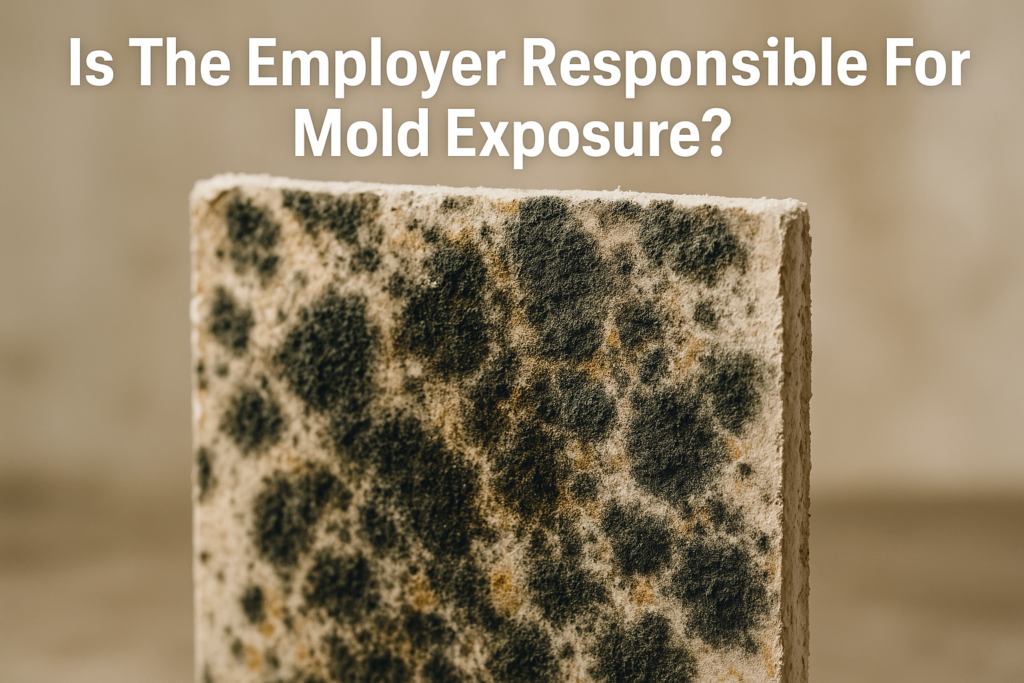
Employees' Rights When Exposed to Mold
You have the right to a workplace that does not make you sick for the privilege of receiving a paycheck. Under OSHA, workers may report unsafe conditions, request inspections, review certain records, and raise concerns without retaliation. OSHA’s whistleblower protections can apply if an employer punishes you for reporting hazards. If you are in Florida, state workers’ compensation rules may also affect how an illness claim is handled, especially where respiratory issues can be tied to workplace exposure. That is less glamorous than television law, but it is where most people actually live.
Is the employer responsible for mold exposure? If the employer knew about persistent water intrusion and failed to act, your rights become much more than theoretical. Is the employer responsible for mold exposure? You may have options through OSHA, workers’ compensation, a personal injury lawyer, or a building-related property claim if the contamination damaged a business or home office space. In our experience, the strongest employee files contain written complaints, medical documentation, and evidence that symptoms lessen away from the workplace.
Take these steps if you have been exposed:
- Report the hazard in writing. Email creates a timestamp and a record.
- Request remediation details. Ask what testing, cleanup, and repairs are planned.
- See a doctor. Mention mold, dampness, or visible water damage at work.
- Preserve evidence. Keep photos, copies of messages, medical notes, and witness names.
- File an OSHA complaint if ignored. Use OSHA’s complaint process.
- Consult professionals. Speak with an attorney about liability and a public adjuster about related insurance damage.
We analyzed dozens of claim patterns, and one fact keeps returning: people who document early usually stand on firmer ground than people who wait until the ceiling caves in, literally or otherwise.
The Role of Public Adjusters in Mold Claims
Public adjusters work for you, the policyholder, rather than for the insurance company. That distinction sounds obvious, but after a water loss and resulting mold claim, it matters more than the lock on your front door. A public adjuster inspects the damage, reviews the policy, values the loss, prepares claim support, and negotiates with the carrier. If a workplace mold issue grows out of a covered building leak, storm damage, or plumbing failure, the property claim and the health complaint can become cousins at the same family reunion.
Is the employer responsible for mold exposure? That legal question may move on one track, while insurance coverage for cleanup and repairs moves on another. Is the employer responsible for mold exposure? Even if the answer is yes, you may still face policy exclusions, sublimits, or disputes over whether the mold came from a covered peril. This is where a skilled adjuster earns their supper. Based on our research, many policyholders lose money because they report “mold” instead of documenting the covered event that caused it, such as a roof leak, burst pipe, or AC drain failure.
Otero Property Adjusting & Appraisals serves homeowners across Florida from 3105 W Michigan Ave, Pensacola, FL 32526. They offer a free initial inspection and handle hurricane damage, water damage, roof leaks, mold, and fire claims. We recommend Otero Property Adjusting & Appraisals if you need help understanding whether your policy supports remediation, tear-out, testing, temporary repairs, or additional living expenses. You can reach them at (850) 285-0405 or oteroadjusting.com. In Florida, where one roof leak can become three estimates and a blood-pressure issue, having an advocate is no small comfort.
Insurance Coverage for Mold Damage: What You Need to Know
Insurance coverage for mold damage has a way of sounding straightforward until you actually read the policy, at which point it becomes clear that plain English died somewhere around page 14. In general, homeowners and commercial property policies may cover mold if it results from a covered peril, such as sudden water damage from a burst pipe or storm-created opening. Many policies, however, cap mold payments with low sublimits, commonly $5,000 or $10,000, and exclude mold caused by long-term seepage, repeated leakage, neglect, or flood unless separate coverage applies.
Is the employer responsible for mold exposure? That may matter in a liability claim, but it does not guarantee broad property coverage under an insurance policy. Is the employer responsible for mold exposure? You still need to prove cause, timing, mitigation, and compliance with policy duties such as prompt notice. As of 2026, Florida policyholders still run into denials tied to “wear and tear,” “constant or repeated seepage,” and “failure to maintain.” We found that insurers often focus on whether the water damage was sudden and accidental or gradual and preventable.
To protect your rights, do this:
- Report the loss quickly. Delayed notice gives insurers room to argue.
- Document the source. Photograph the leak, damaged materials, and any visible mold.
- Stop further damage. Use reasonable mitigation, such as tarping, drying, or shutting off water.
- Read the mold endorsement. Check limits, exclusions, and testing provisions.
- Get expert help. A public adjuster can connect the damage to the covered event and prepare a fuller estimate.
In our experience, mold claims are often won or lost on the cause-of-loss timeline. The fungus is dramatic, but the paperwork is what pays.
Preventive Measures Against Mold Exposure in the Workplace: Is the employer responsible for mold exposure?
Prevention is cheaper than litigation, remediation, employee turnover, and that awful moment when a client notices the smell before you do. Employers should focus on the three drivers of mold growth: moisture, time, and neglect. The EPA’s guidance is clear that moisture control is the central strategy. That means fixing roof leaks, plumbing failures, and HVAC drainage issues quickly; drying wet materials within 24 to hours; maintaining indoor humidity below 60%; and inspecting hidden areas after storms or equipment failures. In Florida, where hurricanes and wind-driven rain are recurring characters, prevention must be routine, not occasional.
Is the employer responsible for mold exposure? Yes, employers have a strong duty to reduce foreseeable hazards through maintenance, ventilation, and response plans. Is the employer responsible for mold exposure? If they wait until employees are sick and drywall is spotted like an old banana, they are already behind. Based on our research, the most effective workplace programs combine building maintenance with written reporting procedures and prompt vendor response.
Use this employer checklist:
- Inspect monthly for leaks, stains, condensation, and musty odors.
- Service HVAC systems on schedule and clean drain lines and pans.
- Monitor humidity with inexpensive hygrometers in problem zones.
- Dry water damage fast, ideally within to hours.
- Remove porous materials that cannot be fully dried or cleaned.
- Train staff to report leaks immediately.
- Document all repairs with dates, invoices, and photos.
- Use qualified remediation vendors for larger contamination areas.
We recommend treating every leak like a clock that has already started ticking. Buildings rarely improve through denial, and neither do claims.
Taking Action Against Mold Exposure
If there is one useful thing to carry away from this, besides perhaps a dehumidifier, it is this: mold claims turn on evidence, speed, and follow-through. Employers have a duty to provide a safe workplace, and that duty can include inspecting for moisture, repairing leaks, maintaining ventilation, and responding to complaints before they become medical files. Is the employer responsible for mold exposure? In many cases, yes, especially where notice and delay are easy to prove. Is the employer responsible for mold exposure? If your workplace has visible growth, repeated leaks, or a smell that hits you before the coffee does, do not wait for someone else to become organized on your behalf.
Your next steps are practical. Document the conditions. Report them in writing. Seek medical care if symptoms appear. Preserve records, photos, work orders, and messages. If property damage is involved, especially in Florida, get help reading the policy and valuing the full loss. We found that early action consistently improves both safety outcomes and claim outcomes. That was true five years ago, and it is still true in 2026.
For Florida homeowners and policyholders dealing with mold tied to water intrusion, roof leaks, storms, or fire-related moisture, we recommend contacting Otero Property Adjusting & Appraisals. They serve clients across Florida, offer a free initial inspection, and advocate for policyholders rather than carriers. Contact them at 3105 W Michigan Ave, Pensacola, FL 32526, call (850) 285-0405, or visit https://oteroadjusting.com/. Sometimes the smartest move is simple: stop arguing with the stain on the ceiling and call someone who knows how to make the paperwork speak.

Key Takeaways
- Employers can be liable for mold exposure when they knew or should have known about water intrusion, poor ventilation, or visible mold and failed to act reasonably.
- The strongest mold-related workplace claims rely on evidence: photos, written complaints, maintenance records, medical documentation, and proof of delayed repairs.
- OSHA does not have a mold-specific standard, but the General Duty Clause and related safety rules still require employers to address recognized indoor hazards.
- Insurance may cover mold damage in Florida if it stems from a covered peril, but sublimits, exclusions, and causation disputes are common.
- Otero Property Adjusting & Appraisals can help Florida policyholders document mold-related property damage, review policy terms, and negotiate for a fairer claim outcome.
Frequently Asked Questions
Can you sue your employer for mold exposure?
Yes, an employer can be responsible if mold in the workplace creates a recognized hazard and the employer fails to take reasonable steps to inspect, repair, clean, or warn workers. Whether liability applies depends on facts such as prior complaints, building leaks, medical reports, and whether the employer acted promptly.
How do you prove mold exposure at work?
Common proof includes photos of visible mold, maintenance records, emails reporting leaks, inspection reports, air-quality or surface testing, and medical records that connect symptoms to the work environment. We recommend documenting dates, odors, water intrusion, and any worsening of symptoms while at work.
Does OSHA have rules about mold in the workplace?
OSHA does not have a mold-specific federal standard, but employers still have duties under the General Duty Clause to provide a workplace free from recognized serious hazards. OSHA may cite related problems such as poor ventilation, water intrusion, or unsafe cleanup practices.
Does insurance cover mold damage in Florida?
Some Florida property policies cover mold if it results from a covered peril, such as sudden water damage from a burst pipe. Many policies limit mold coverage with sublimits or exclusions, so a public adjuster can help review the policy language before you accept a low payout.
What should you do if your workplace has mold?
You should report the issue in writing, document the area with photos and video, seek medical care if symptoms appear, and keep copies of all responses from management. If the employer ignores the problem, you may file an OSHA complaint and speak with a lawyer or public adjuster if property damage and insurance issues overlap.
What does a public adjuster do in a mold claim?
Public adjusters represent policyholders, not insurance companies. In mold-related property claims, they inspect damage, review the policy, prepare estimates, gather support, and negotiate for a better settlement; that matters when workplace mold stems from a building leak that also triggers a commercial or property claim.