
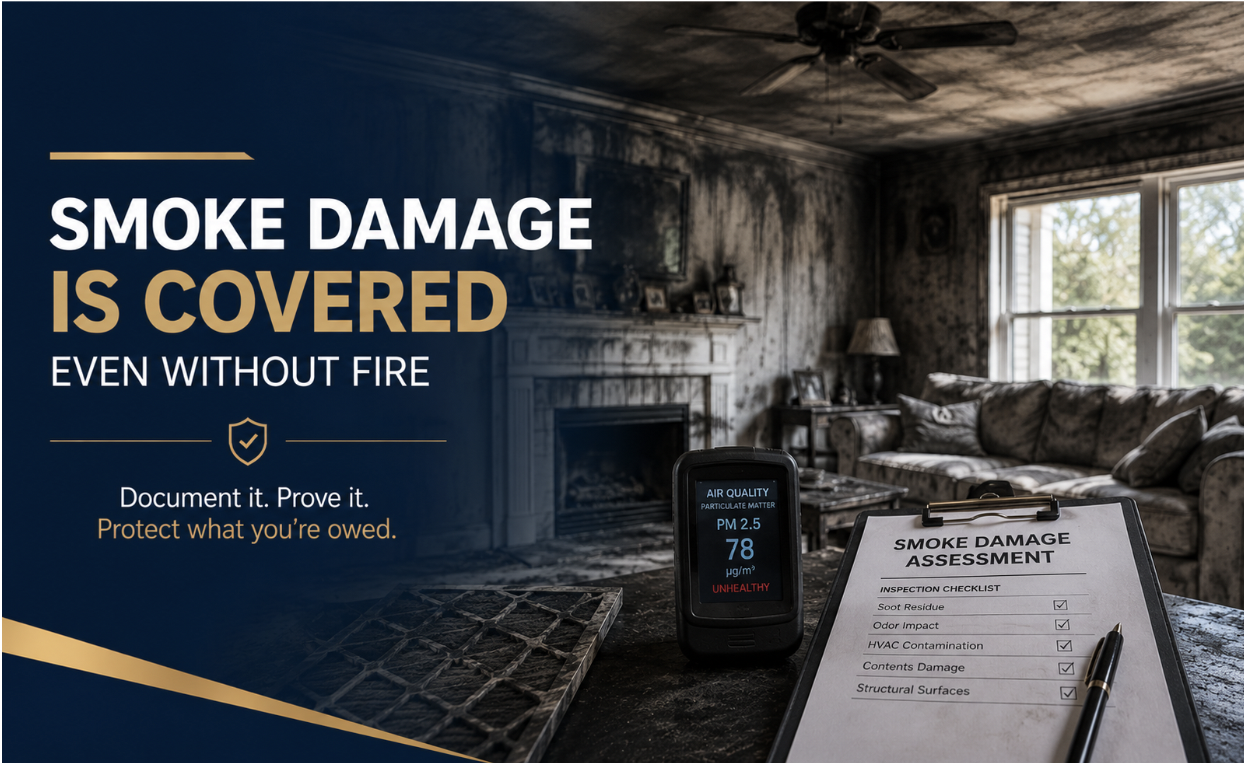
The smell is still in the walls. The HVAC system pushed smoke through every room. Your furniture is stained, your electronics are coated in soot, and the insurance company is telling you the damage isn’t significant enough to warrant a full payout – because the fire didn’t touch your home directly.
That response is not a final answer. It’s an opening position.
What Does a Smoke Damage Insurance Claim Actually Cover?
A smoke damage insurance claim is a formal request under your homeowner’s or commercial property policy for compensation related to smoke, soot, and ash infiltration – even when no fire directly burned your structure. Most standard HO-3 homeowner policies in Florida cover smoke damage as a named peril, meaning coverage exists whether the smoke originated inside your home or from an external source like a neighbor’s fire or a wildfire. The critical issue is documentation and professional assessment – not whether flames touched your property.
Key Takeaways
• Smoke damage is a covered peril under most standard Florida homeowner policies, independent of direct fire contact
• Insurance companies routinely undervalue smoke claims because soot and odor damage is harder to photograph than structural fire damage
• Hidden smoke damage – inside HVAC systems, wall cavities, and ductwork – is frequently missed in initial insurer inspections
• Documenting smoke damage requires air quality testing, HVAC inspection reports, and contents inventories, not just visual photos
• A licensed public adjuster works exclusively for you – not the insurance company – and costs nothing upfront
Why Do Homeowners Assume Smoke Damage Isn’t Covered?
The assumption starts with a reasonable instinct: fire insurance covers fire. If there was no fire in your home, there must not be a claim.
That instinct is exactly what insurance companies benefit from.
Standard HO-3 policies – the most common homeowner policy in Florida – list “smoke” as a named covered peril under Section I. The coverage applies whether the smoke came from your own kitchen fire, a neighbor’s structure fire, or a wildfire burning miles away. The Florida Department of Financial Services confirms that smoke is explicitly listed as a covered cause of loss in most residential property policies issued in the state.
The misconception persists because insurance companies don’t correct it. An adjuster who arrives at your home, sees no charred walls, and writes a minimal estimate has no incentive to explain that your HVAC system just distributed smoke particles through 2,000 square feet of living space.
Smoke damage claims fail not because the coverage doesn’t exist – they fail because policyholders don’t know what they’re entitled to document.
What Makes Smoke Claims Harder to Prove Than Fire Claims?
This is where the real challenge lives – and why so many smoke damage insurance claims get underpaid.
Fire damage is visible. Smoke damage is systemic.
Soot infiltrates wall cavities, settles into insulation, coats HVAC coils, and embeds in porous materials like drywall, wood framing, and upholstery. The damage is real, measurable, and expensive to remediate – but it doesn’t photograph the way a burned roof does. That invisibility is the structural reason smoke claims are consistently undervalued.
The Smoke Damage Scope Gap is the difference between what a standard insurance field adjuster documents in a visual inspection and what a thorough professional assessment actually finds. Practitioners at Otero Property Adjusting & Appraisals regularly identify scope gaps in smoke claims that include: missed HVAC contamination requiring full system cleaning or replacement, contents losses the insurer’s estimate ignored entirely, and odor remediation costs that require ozone treatment or full drywall replacement – not just surface cleaning.
One scenario: a homeowner near Pensacola experienced a neighbor’s garage fire. No flames crossed the property line. The insurer’s initial estimate covered surface cleaning – roughly $4,200. After a full public adjuster assessment that included HVAC inspection, air quality sampling, and a detailed contents inventory, the documented scope expanded to include duct cleaning, furniture replacement, and structural deodorization. The revised claim settled significantly higher than the original offer.
That gap isn’t unusual. It’s the norm for smoke claims handled without professional representation.
How Do You Actually Document a Smoke Damage Claim Correctly?
Documentation is the mechanism that converts real damage into compensable loss. Without it, the insurance company’s number stands.
Here’s what thorough smoke damage documentation requires:
1. Immediate preservation. Don’t clean anything before documenting. Photograph every affected surface, room, and item. Soot is evidence.
2. HVAC system inspection. Hire a certified HVAC technician to inspect and document contamination in ductwork, coils, and filters. This report becomes a line item in your claim.
3. Air quality testing. Industrial hygienists can test for particulate matter and volatile organic compounds. This creates objective, third-party documentation of air contamination – harder for an insurer to dismiss than homeowner photos.
4. Contents inventory. List every damaged item with its pre-loss value, age, and replacement cost. Electronics, clothing, furniture, and food are all potentially compensable.
5. Written contractor estimates. Get written remediation estimates from licensed contractors. Verbal assessments don’t move claims.
The insurance company has a documented process for minimizing your claim. You need an equally documented process for maximizing it.
What’s the Difference Between Handling This Yourself and Hiring a Public Adjuster?
| Factor | Handling It Yourself | Working with a Public Adjuster |
| Who reviews your policy | You | Licensed adjuster with claims expertise |
| Scope of damage documented | Visual, surface-level | Structural, HVAC, contents, air quality |
| Negotiating leverage | Limited – you’re one homeowner | Professional representation with documented evidence |
| Time investment | High – forms, calls, follow-ups | Low – adjuster manages the process |
| Upfront cost | None | None – contingency fee from settlement |
| Typical outcome | Initial offer or slightly above | Documented cases of significantly higher settlements |
A public adjuster is a licensed professional who represents policyholders – not insurance companies – in the claims process. That distinction matters because the insurer’s adjuster, however polite, is paid to protect the insurer’s interests.
Otero Property Adjusting & Appraisals works exclusively for the policyholder. No upfront fees. The firm’s compensation comes as a percentage of the final settlement, which means their financial incentive is directly aligned with maximizing your recovery. Understanding what are the responsibilities of a claims adjuster helps explain why the insurer’s representative and a public adjuster approach the same claim from fundamentally different positions.
The Contrarian Truth About “Small” Smoke Claims
Here is the claim most people don’t expect: a smoke claim with no structural fire damage is often more complex – and more valuable – than a straightforward fire claim.
Why? Because fire damage is contained and visible. Smoke damage is diffuse and hidden. A fire that burns one room has a clear perimeter. Smoke from that same fire may have traveled through the entire HVAC system, contaminated every room, and rendered the home temporarily uninhabitable – creating a loss that exceeds the fire damage itself.
The second assumption worth challenging: that a quick insurance settlement is a good one. Insurance companies are operationally incentivized to close claims fast. Speed benefits them, not you. A claim closed in two weeks is almost never a claim that was fully documented. Practitioners consistently report that thorough smoke claims – with HVAC reports, air quality testing, and contents inventories – take four to eight weeks to document properly and settle for materially more than fast-close offers.
Patience, documentation, and professional representation are the mechanism. The higher settlement is the result. Knowing how to respond to a low settlement offer before you’re pressured to accept one is one of the most valuable preparations a homeowner can make.
Who Is This Approach Not Right For?
Honest answer: not every smoke damage situation warrants full public adjuster engagement.
If the smoke damage is genuinely limited – a single room, no HVAC involvement, minimal contents loss, and the insurer’s estimate covers actual remediation costs – hiring a public adjuster may not add value proportionate to the contingency fee.
This approach delivers the most value when: the damage is diffuse across multiple rooms or systems, the initial insurance offer feels significantly below actual repair costs, the HVAC system was involved, or the homeowner lacks time or expertise to manage a complex claim.
Otero Property Adjusting & Appraisals offers consultations to assess whether professional representation makes sense for your specific situation – before any commitment is made.
Frequently Asked Questions
Does my homeowner’s insurance cover smoke damage if the fire was at my neighbor’s house?
Yes, in most cases. Standard HO-3 policies in Florida list smoke as a covered peril regardless of where the fire originated. If smoke entered your home and caused documented damage, you likely have a valid claim. A licensed public adjuster can review your specific policy language to confirm.
How long do I have to file a smoke damage claim in Florida?
Florida Statute 627.70132 generally requires that hurricane-related claims be reported within three years of the loss date, but non-hurricane property damage claims have different timelines depending on your policy. Most policies require “prompt” notice of loss – meaning you should report smoke damage as soon as it’s discovered, not weeks later.
Will filing a smoke damage claim raise my insurance rates?
Filing a claim can affect your premium at renewal, but this concern shouldn’t stop you from claiming legitimate damage you’re entitled to. The more relevant question is whether your undocumented damage will cost you more out-of-pocket than the potential premium adjustment. A public adjuster can help you think through that tradeoff honestly.
What if the insurance company already sent an adjuster and made an offer?
An initial offer is not a final settlement. You have the right to dispute the amount, request a re-inspection, or invoke the appraisal clause in your policy. Otero Property Adjusting & Appraisals regularly reopens and supplements claims where the initial offer was inadequate.
Can smoke damage make a home uninhabitable, and is that covered?
Yes. If smoke contamination renders your home temporarily uninhabitable, most policies include Additional Living Expenses (ALE) coverage that pays for hotel, meals, and other costs while remediation occurs. This coverage is frequently overlooked in initial insurer estimates.
How does a public adjuster’s fee work on a smoke damage claim?
Public adjusters in Florida are licensed and regulated by the Florida Department of Financial Services. They typically charge a contingency fee – a percentage of the final settlement – with no upfront cost to the homeowner. The fee is paid from the settlement, not out of pocket.
What’s the difference between a public adjuster and a contractor who handles insurance claims?
A public adjuster is a licensed claims professional who represents you in the insurance process – reviewing your policy, documenting damage, and negotiating with the insurer. A contractor estimates repair costs but is not licensed to interpret your policy or negotiate your settlement. These are complementary roles, not interchangeable ones.
If Your Smoke Damage Claim Has Already Been Lowballed, There’s Still Time
The insurance company made their first move. You haven’t made yours yet.
If you’re sitting with an offer that doesn’t cover your actual remediation costs – or if you haven’t filed yet and aren’t sure what you’re entitled to – contact Otero Property Adjusting & Appraisals for a no-cost claim consultation.
Serving homeowners and property owners from Miami to Pensacola and across the Florida Panhandle.
Schedule your consultation at oteroadjusting.com – before you accept a number that doesn’t reflect your real loss.
References
Florida Department of Financial Services – Policyholder rights, covered perils under standard homeowner policies, and public adjuster licensing requirements in Florida.
Florida Statute 627.70132 – Florida law governing property insurance claim reporting timelines, including hurricane and non-hurricane loss provisions.
Florida Department of Financial Services, Division of Consumer Services – Public adjuster regulation, fee structures, and licensing standards for Florida-licensed adjusters.